© Philipp Zieger

20 Years of Painter's Way

 (2006-2026)

Malerweg Jubiläumslogo

Between the wide valleys and rugged rocks of the Elbe Sandstone Mountains, painters, poets, and composers were once drawn to places where the landscape unfolded its greatest charm. Their works left traces—not on stone, but in the imagination, inspired by a common route: the Painter's Path. This trail, which many artists have walked, made the region between Pirna and the Großer Winterberg widely known. In 2006, exactly 20 years ago, the Painter's Path was awakened from its slumber with the support of numerous regional partners. Today, it largely follows its historical course, inviting visitors to discover the beauty of Saxon Switzerland through the eyes of the Romantics.
"I had a fantastic week on the Malerweg and the fixed accommodation, which I was initially skeptical about, had several enormous advantages. The guest card mobile was amazing and the key to this type of hiking. The connections were almost always seamless, the internet information always available, and the stops easy to find. I also noticed that the announcements on the buses matched the stops, which is very important for tourists unfamiliar with the area. Only from Weißig did I have no possibility to travel or get there on the holiday and Saturday. So I continued on to Rathen and climbed again the next day."
Kathrin Albrecht (Hiking Guest from Beelitz)
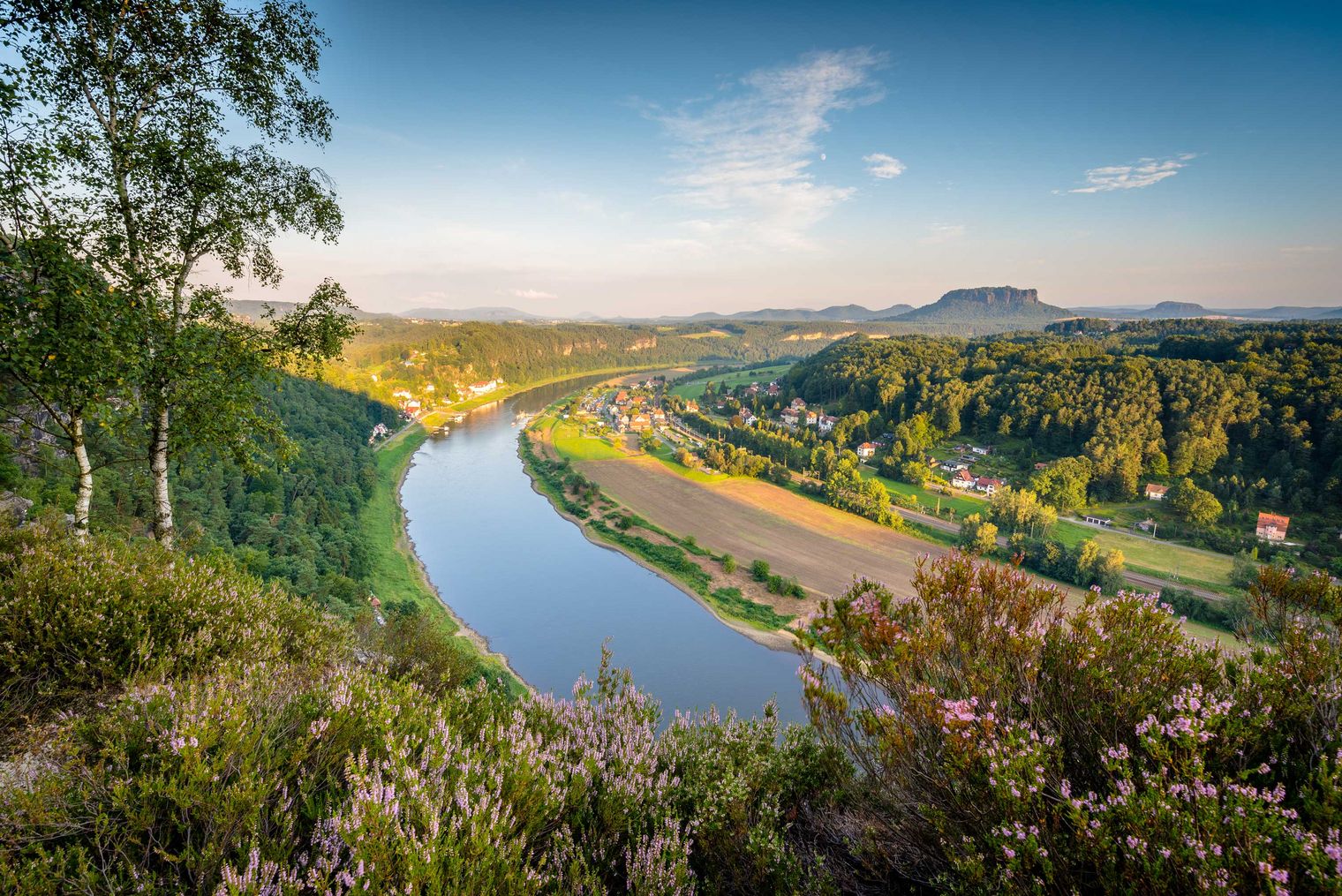
Blick auf die Elbe, umgeben von grünen Hügeln und Bäumen, unter einem klaren Himmel.
© Jacqueline Günther

The Painter's Way: Yesterday and Today

The birth of today's Malerweg was on June 10, 2006. Manuel Andrack, then known as the co-host and sidekick of entertainer Harald Schmidt, praised the Saxon Switzerland in his book "Du musst wandern" and became an ambassador for the newly established Malerweg. It didn't take long before the Malerweg became a magnet for hikers from near and far. Thus, it is not surprising that just one year after its official opening, it secured second place in the "Hiking Destination of the Year" public vote in 2007, which attests to the hiking quality and unique natural experience.

To this day, 20 years later, the Malerweg is the hiking highlight of the region and has not lost its appeal. Quite the opposite: in the public vote for "Germany's Most Beautiful Hiking Trail 2023," the Malerweg achieved third place. This remarkable performance is owed to numerous volunteers, such as trail wardens who regularly check the paths and signage. Another clear advantage: with the guest card, the start and end points of the stages are accessible by bus and train at no extra cost. This allows for a central choice of accommodation while preserving nature. Because it is not the destination that is important, but the journey...and the Malerweg is an especially beautiful one. 

"Be prepared to witness an unbroken series of natural beauties and rarities from now on, which increase in grandeur, beauty, and scope the further you go. The eyes will have a feast for several days, providing the most beautiful nourishment for spirit and heart."
Wilhelm Leberecht Götzinger (1804)
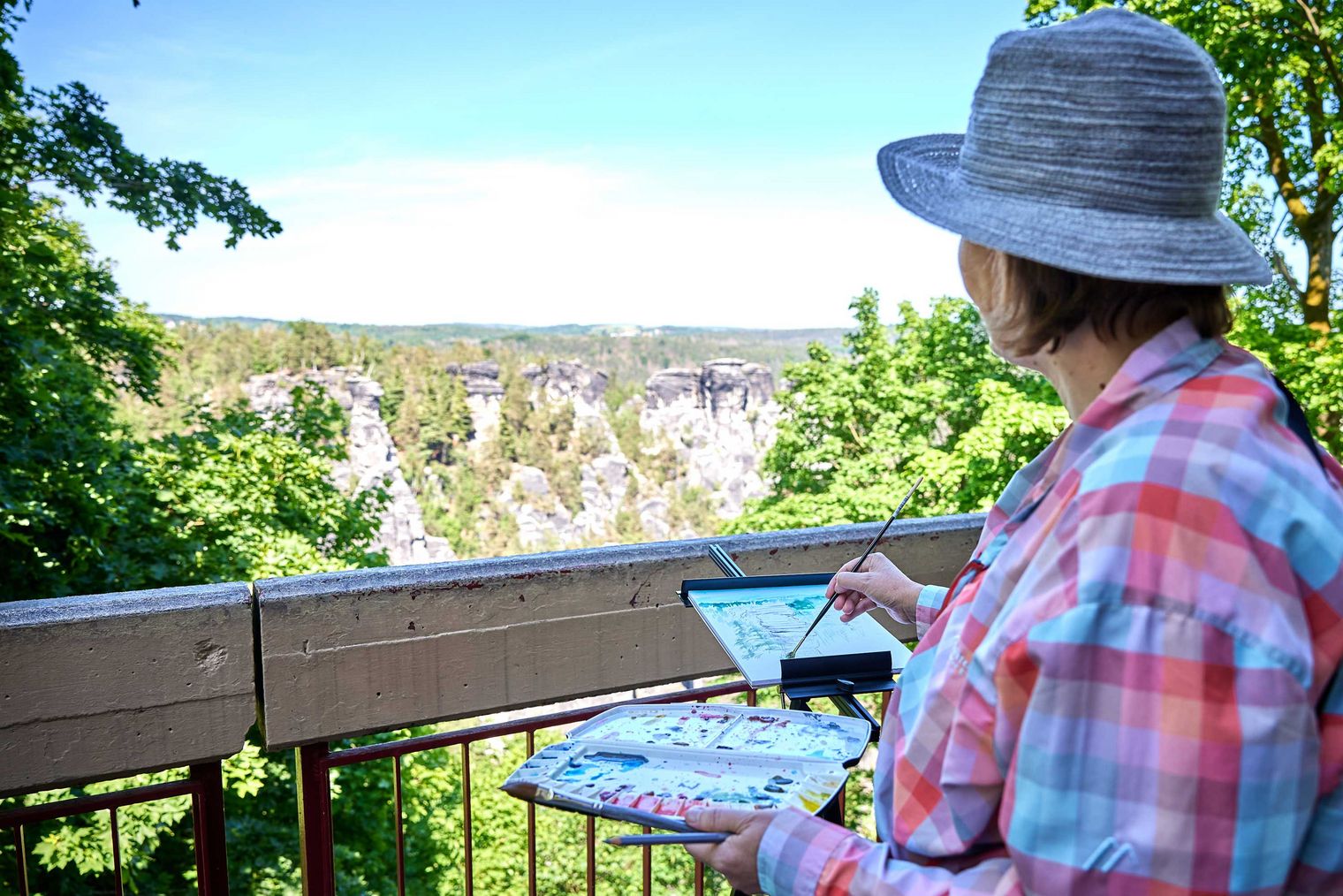
Frau mit Hut malt Landschaft von einer Aussichtsplattform aus, umgeben von Bäumen.
© Marko Förster

Art and Nature

Since the mid-18th century, Saxon Switzerland with its unparalleled landscape has been a popular destination for painters. It began with Johann Alexander Thiele, a painter at the Dresden court of Augustus III and founder of the Dresden Academy of Fine Arts. His baroque era was replaced in the 19th century by Romanticism, where emotion and passion dominated. In German painting, no one embodied this better than Caspar David Friedrich, who painted numerous works in Saxon Switzerland.

These are just two of the many artists who traveled on specific routes through the Elbe Sandstone Mountains in the 18th and 19th centuries and were continually inspired anew. With the construction of the railway and the emergence of new styles, these routes gradually faded into oblivion, until they were revived in the 20th century, initially as the Painter's Road and later as the Historical Painter's Path.

Today, hikers on the Painter's Path find glass information steles featuring famous paintings and sketches by historical artists. They invite comparisons between the artworks and today's view of nature. Even for modern artists, the Painter's Path remains an important source of inspiration with exhibitions and painting courses.

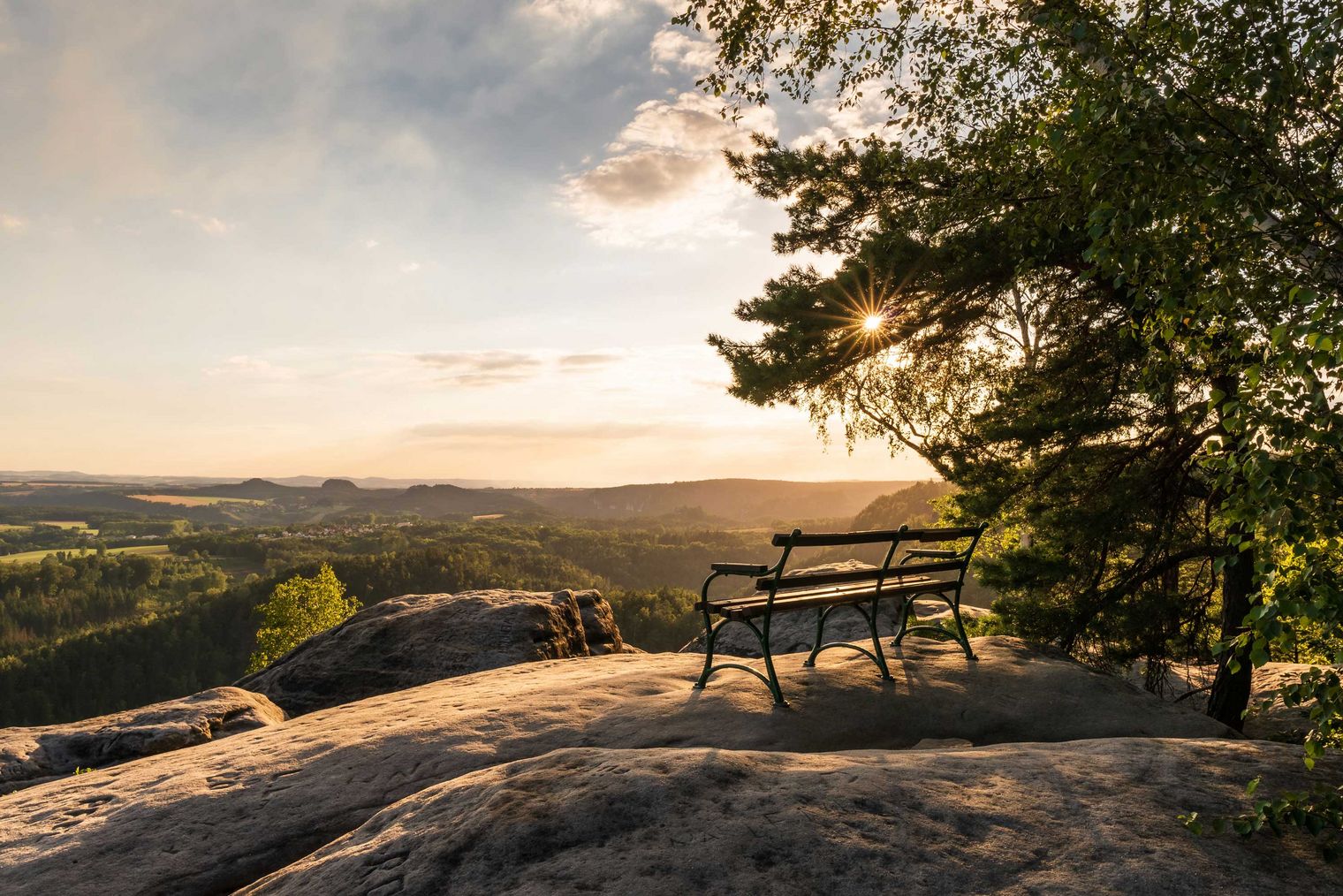
Blick auf die Landschaft mit einer Bank auf einem Felsen, umgeben von Bäumen bei Sonnenuntergang.
© Philipp Zieger

Photo Competition: Bright Spots on the Painter's Way

On the occasion of the 20th anniversary of the Malerweg, a photography competition will be held with two themes/categories: "The Malerweg through the Seasons" and "Historical Painter's Views - Then & Now". The competition invites you to discover the landscape along the Malerweg through photography. Both in its seasonal diversity and in dialogue with historical image perspectives.

The awarding of the works selected by the jury will take place during the 10th Globetrotter Hiking Days, on September 19, 2026. There will subsequently be an exhibition of the awarded photographs at the National Park Center Bad Schandau.

The photography competition is aimed at all photography enthusiasts and Malerweg hikers with a passion for photography.

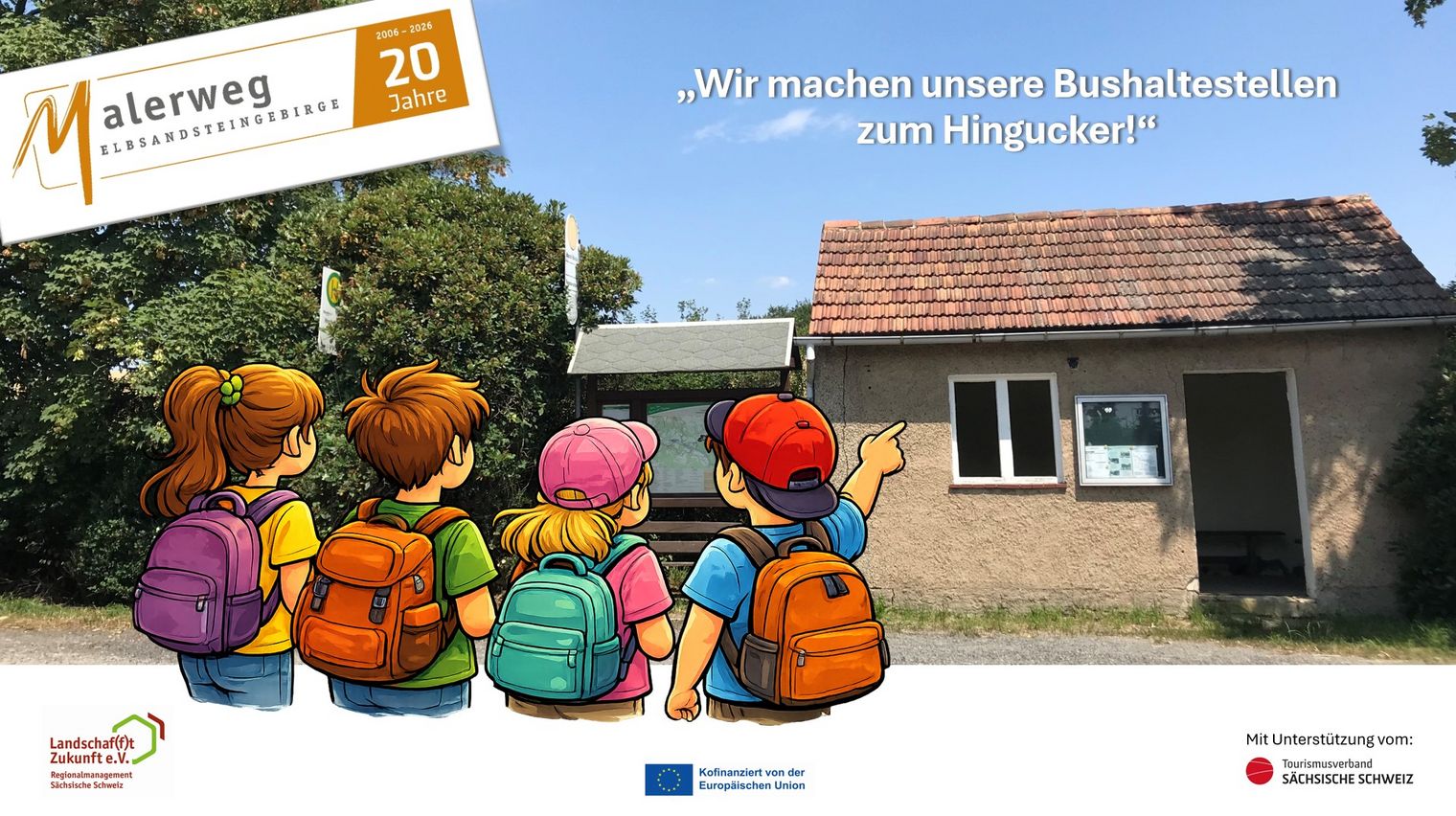
Kinder mit Rucksäcken stehen vor einem Haltestellenhäuschen mit einem Fenster und einem Schild zur 20-Jahr-Feier des Malerweg.
© Landschaf(f)t Zukunft e.V. | AI-optimized

Competition: Painter's Way bus stops become eye-catchers

The Regional Management Saxon Switzerland of the association "Landscaping Future" calls, in collaboration with the Saxon Switzerland Tourism Association e. V., for a creative competition: "20 Years of Painter's Path - We Make Our Bus Stops Eye-Catchers!" We are looking for creative ideas, designs, and concepts for the design and beautification of bus stops along the Painter's Path in the LEADER region of Saxon Switzerland.

This action aims to make the anniversary of the popular hiking trail visible in public spaces - at the places where locals and guests daily board, disembark, and linger.

Whether artistic designs, informative panels, landscape-inspired creations, or creative participatory activities - sustainable, original, and location-related contributions are sought that reflect the beauty of Saxon Switzerland and the significance of the Painter's Path. A jury will select the best ideas, which will then be awarded with the support of the initiators.

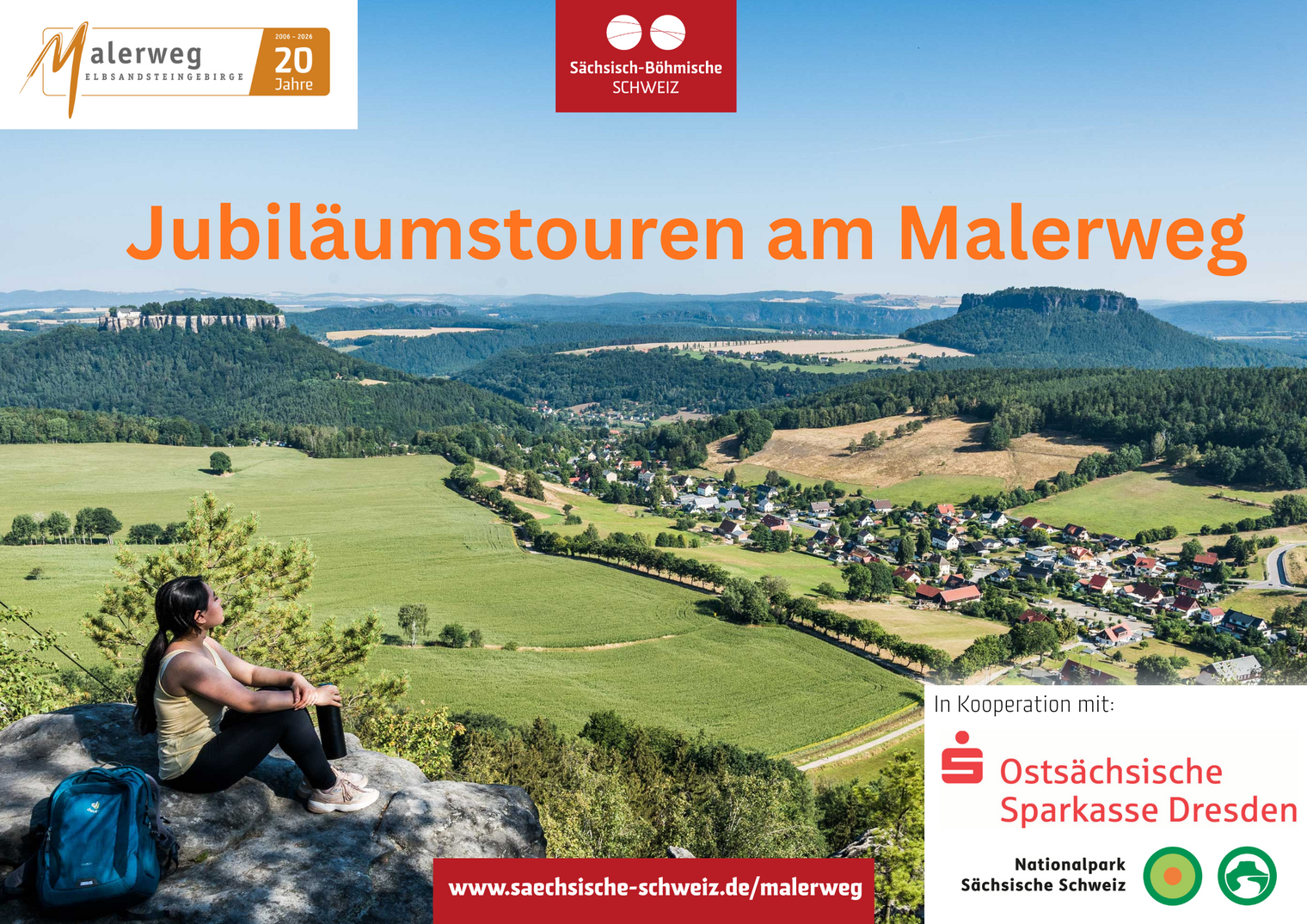
Blick auf eine grüne Landschaft mit Hügeln und Wäldern, eine Person sitzt auf einem Felsen.
© Sebastian Thiel

Anniversary Tours: The Malerweg for Insiders

From March to October, special anniversary tours on the Malerweg invite you to discover the famous hiking trail from a new perspective. Once a month, each on a Sunday, a selected stage is explored together with expert guidance.  Each tour is accompanied by a representative of the Saxon Switzerland National Park and Forestry Administration. In addition, there are other participants who have significantly influenced the Malerweg or have accompanied its development over the years, providing exciting insights firsthand.

The anniversary tours are kindly supported by the East Saxon Savings Bank Dresden and the Saxon Switzerland National Park and Forestry Administration.

Special Exhibition: Inspiration Painters' Trail

On the occasion of the 20th anniversary of the Painter's Way, a significant piece of art and cultural history returns to the public. In the special exhibition “Inspiration Painter's Way” at the Parkhotel Bad Schandau, selected reproductions of paintings, drawings, and sketches from the Hasse Foundation will be displayed from April 17, 2026, whose motifs can be found along the Painter's Way. Additionally, the exhibition features an exclusive selection of contemporary works by regional female artists - Claudia Pinkau & Heike Küchler (Galeriewerkstatt Ansichtssache) as well as Andrea Molière (Molière artdesign) - thus bridging the gap between historical and modern interpretations.

The collection founded by Ursula and Dietrich Hasse comprises around 500 sheets from the 15th to the 20th century, including works by well-known artists such as Johann Alexander Thiele, Canaletto, and Adrian Zingg. Many views are located directly along the route and clearly demonstrate how closely art, landscape, and the tourism development of the Saxon Switzerland are intertwined.

Admission free
daily from 10 AM to 5 PM at Parkhotel Bad Schandau

"With the help of your homepage malerweg.de, I planned our hike along the Malerweg trail. The GPX tracks of the individual tours proved to be very helpful, easing navigation in advance. We found that the Malerweg is excellently marked in nature and easy to find. We were delighted to find accommodation even for just one night. The luggage transport via Bag&Bike worked excellently. The days in Saxon Switzerland will remain in very good memory for us."
Jutta Pauli (Hiking Guest from the Mühlenbecker Land)

The 20 most beautiful places on the Painter's Way

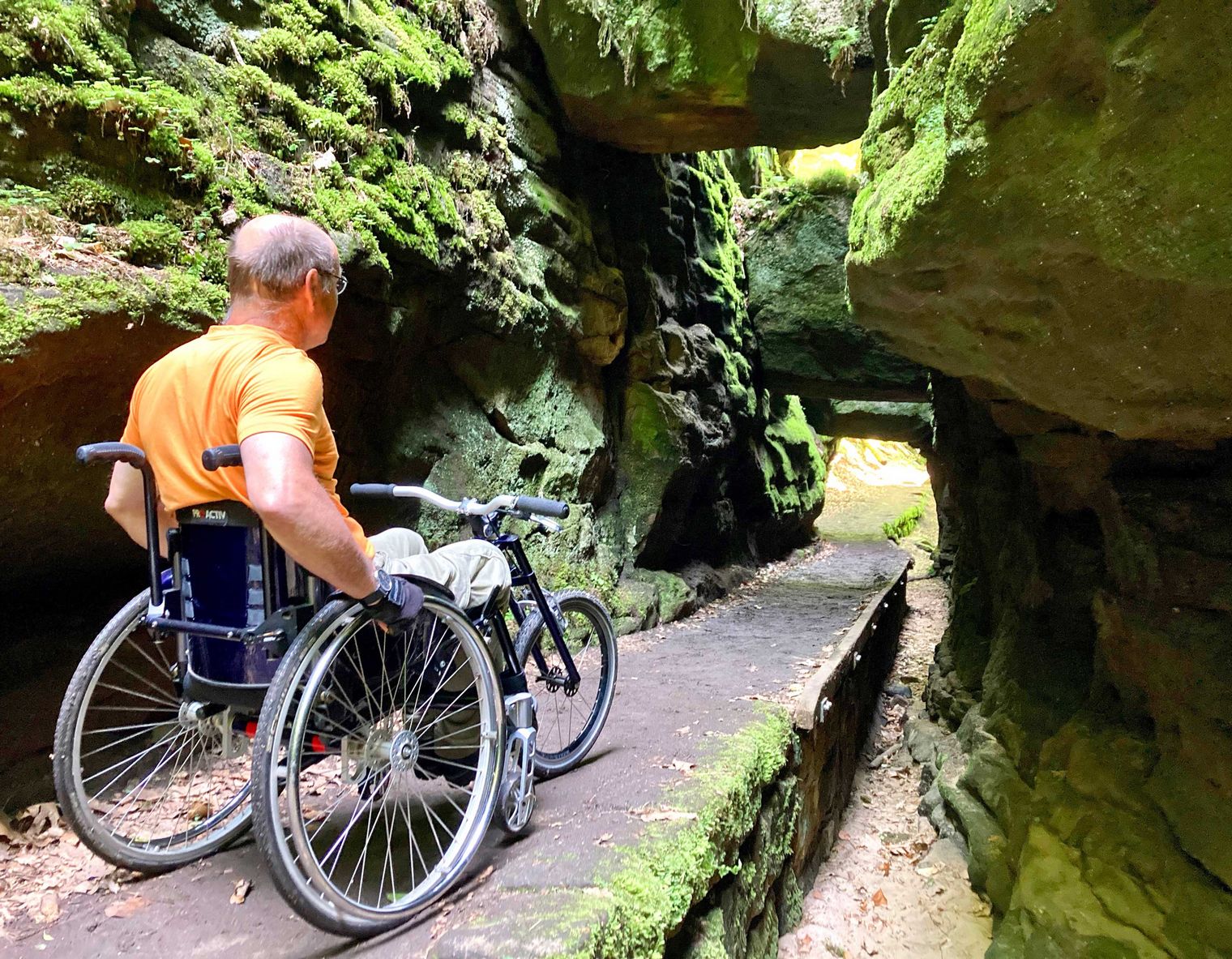
Felsentor im Uttewalder Grund mit moosbedeckten Felsen und einem schmalen Weg in der Mitte.
© Philipp Zieger

Uttewalder Grund

The Uttewalder Grund is a deep, sometimes narrow gorge that reaches its climax at the Uttewalder Rock Gate. Representations of the Uttewalder Rock Gate marked a turning point in landscape perception at the end of the 18th century. Caspar David Friedrich sought solitude in the area for several days and sketched the landscape.

Blick auf Turm der neuen Burg Wehlen auf einem Hügel, umgeben von Bäumen und Nebel, mit Häusern im Vordergrund.
© Mandy Krebs

Castle Town Wehlen

Wehlen Castle - the third oldest in Saxony - rises prominently above the Elbe on a distinctive rocky spur in the town of Wehlen. Some ring walls, a vaulted cellar, the foundations of a tower, and the round bastion tower ("Drum") have been preserved. After a long construction period, an observation tower, based on the historical walls, has been open to visitors since 2025 and is a new highlight along the Painter's Path.

Felsenlandschaft mit grünen Bäumen und Wolken im Hintergrund, bei Sonnenaufgang.
© Rico Richter

Bastei Bridge and Bastei Viewpoint

The most prominent sandstone formation featuring an iconic stone bridge and expansive views over the Elbe Valley. An absolute highlight along the Painter's Path. Incidentally, the first version was made of wood before being replaced by the current stone bridge. With its particularly impressive landscape, the Bastei viewpoints offer an abundance of photographic opportunities for both past and present artists and photographers.

Frau mit Rucksack blickt von der Hockstein-Aussicht auf die Stadt Hohnstein.
© Sebastian Thiel

Hockstein Viewpoint

With its 291 meters, the Hockstein offers spectacular views of the Polenz Valley lying 115 meters below. Here, the transition from the Lusatian Thrust to the sandstone is evident, as upstream you will find granite and downstream sandstone. On the Hockstein, the remains of a medieval fortification can be found.

Hohe, schneebedeckte Felsen mit sichtbaren Schichten und einer kleinen Baumgruppe im Vordergrund.
© Hans Fineart

Gautsch Grotto

Half-round shaped, imposing yet mysterious. That's how the Gautsch Grotto appears to Malerweg hikers. In winter, when water drips down, interesting ice formations develop on the walls.

Junge Frau mit Rucksack blickt vom Aussichtspunkt an der Brandbaude auf eine grüne Landschaft mit dem Lilienstein im Hintergrund.
© Sebastian Thiel

Brand Viewpoint

A stunning 180-degree panoramic view over the Front and Back Saxon Switzerland with the imposing table mountains on the horizon awaits hikers here at the Brand. "Balcony of Saxon Switzerland," as the Brand viewpoint is also popularly known. For about 200 years, there has also been a mountain inn here. Additionally, it is worth visiting the National Park information center in the log cabin.

Blick auf die Landschaft mit einer Bank auf einem Felsen, umgeben von Bäumen bei Sonnenuntergang.
© Philipp Zieger

Waitzdorf Viewpoint

A small break in a vast landscape. The Waitzdorf Viewpoint is a tranquil and far-reaching viewpoint in the Saxon Switzerland National Park.

Klares Wasser fließt über moosbedeckte Felsen in einer grünen Umgebung.
© St. Dollase-Berger / 42925498 / stock.adobe.com

Lichtenhainer Waterfall

The Lichtenhain Waterfall is one of the few curiosities from the early days of tourism in Saxon Switzerland that has survived to this day. The staged waterfall of the Lichtenhain village brook is created by a weir above the narrow sandstone gorge. With the historical Kirnitzschtalbahn, the only tram in a national park, you can comfortably reach this highlight on the Painter's Pathway.

Zwei Wanderer in bunten Jacken gehen durch einen großen Felsbogen, dem Kuhstall.
© Sebastian Thiel

Kuhstall Rock Gate

The Kuhstall is the largest natural rock gate in Saxon Switzerland and is located on the Neuen Wildenstein above the Kirnitzschtal. The name "Kuhstall" dates back to the Thirty Years' War when the rock served as a hiding place for farmers' livestock.

Sonnenstrahlen scheinen durch eine Felsöffnung der Kleinsteinhöhle.
© Britta Prema-Hirschburger

Kleinstein and Kleinstein Cave

The Kleinsteinhöhle is the second-largest rock arch in Saxon Switzerland, after the Kuhstall. The motif of the Kleinsteinhöhle was drawn by Ludwig Richter during his journey through Saxon Switzerland and later published as an engraving. The summit of the Kleinstein offers a wonderful panoramic view of the Hintere Sächsische Schweiz.

Blick von der Goldsteinaussicht
© Iven Eissner

Goldstein Viewpoint

The Goldstein Viewpoint is an impressive rock view on the Reitsteig above the Großer Zschand with a panorama over gorges and ridges extending into Bohemian Switzerland. A hidden gem among the viewpoints on the Painter's Pathway.

Blick auf eine bewaldete Landschaft mit Felsen und Nebel in der Ferne unter einem leicht bewölkten Himmel.
© Britta Prema Hirschburger

Kaiserkrone

The Kaiserkrone is a table mountain at the foot of which lies a large boulder immortalized in Caspar David Friedrich's famous painting "The Wanderer above the Sea of Fog." The panorama from the rugged Kaiserkrone stretches over the Schrammsteine to the Großer Winterberg and into the Bohemian Switzerland.

Grüne Landschaft mit sanften Hügeln und dem Rosenberg sowie dem Zirkelstein im Hintergrund unter einem farbenfrohen Himmel.
© Philipp Zieger

Wolfsberg

The Wolfsberg is a sandstone knoll south of Reinhardtsdorf-Schöna offering a particularly picturesque view from Zirkelstein into the Bohemian Switzerland. The panoramic restaurant in Swiss style allows guests to enjoy the view while savoring delicious regional cuisine.

Winterlandschaft mit schneebedeckten Bäumen und Felsen, Sonnenaufgang am Horizont.
© Stefan Junghanß

Papststein

In the area known as the "Steine," surrounded by the Gohrisch(stein) and the Kleinhennersdorfer Stein, lies the Papststein. On its plateau, there is a rustic mountain lodge.

Sonnenuntergang über einem nebligen Wald mit Felsen im Vordergrund.
© Philipp Zieger

Gohrisch(stein)

The Gohrischstein is a prominent table mountain on the Painter's Path, offering a comprehensive panorama. The views extend over the left-bank Saxon Switzerland, Zschirnsteine, Papststein, Schrammsteine, Great Winterberg, and into the Bohemian Switzerland, including the Hoher Schneeberg and Lusatian Mountains.

Sonnenuntergang über einer Landschaft mit buntem Laub und markanten Felsen, der Barbarine, im Vordergrund.
© Britta Prema-Hirschburger

Pfaffenstein

The rugged table mountain Pfaffenstein is located on the 7th stage of the Painter's Path. On its plateau stands a lookout tower as well as a historic mountain inn. Hikers on the Painter's Path must not miss the unique rock needle "Barbarine."

Festung Königstein auf einem Hügel, umgeben von Nebel und Bäumen, mit sanften Hügeln im Hintergrund.
© Britta Prema-Hirschburger

Königstein Fortress

At one of Europe's largest mountain fortresses, Malerweg hikers experience history at the original site. Its location on a plateau 247 meters above the Elbe and its history dating back to the Middle Ages make the unconquered fortress unique. Castle, monastery, fortress, prison, youth work farm: Kingstone was all of these. Today, the significant architectural monument, consisting of over 50 buildings and well-maintained gardens, continues to fascinate.

Grüne Hügel und Wälder umgeben ein Tal mit einem kleinen Dorf und Wiesen im Sonnenlicht.
© czech vibes

Thiele Viewpoint

An almost forgotten, revived viewpoint in Thürmdorf, near the Painter's Path Chapel consecrated in 2019. It offers an unparalleled view of the Elbe bend at Königstein, the Königstein Fortress, and the Lilienstein.

Frau sitzt auf einem Felsen und blickt auf eine grüne Landschaft mit Hügeln und Wäldern.
© Sebastian Thiel

Rauenstein

The Rauenstein is a distinctive, rugged plateau mountain. From various vantage points along the ridge path and near the mountain lodge, impressive views unfold: including the Bastei, Lilienstein, Königstein, and the Fortress Königstein. On the Rauenstein, a beautiful mountain lodge with regional cuisine awaits thirsty and hungry hikers.

Wanderer mit Rucksack blickt auf die Stadt Pirna mit roten Dächern und einem hohen Kirchturm im Hintergrund.
© Sebastian Thiel

Sonnenstein Castle

Sonnenstein Castle rises majestically above the old town of Pirna and has a multifaceted history. The 19th-century terraced gardens and the view over the old town are the crowning glory for painters' trail hikers.

Mann im Rollstuhl auf einem schmalen Holzweg zwischen hohen, moosbedeckten Felsen.
© Veit Riffer

Diverse experiences for everyone

The Painter's Path is suitable for multi-day hikes, day trips, and winter walks. Many sections are accessible and offer an inclusive nature experience. A selection of accessible tours along the Painter's Path can be found here.

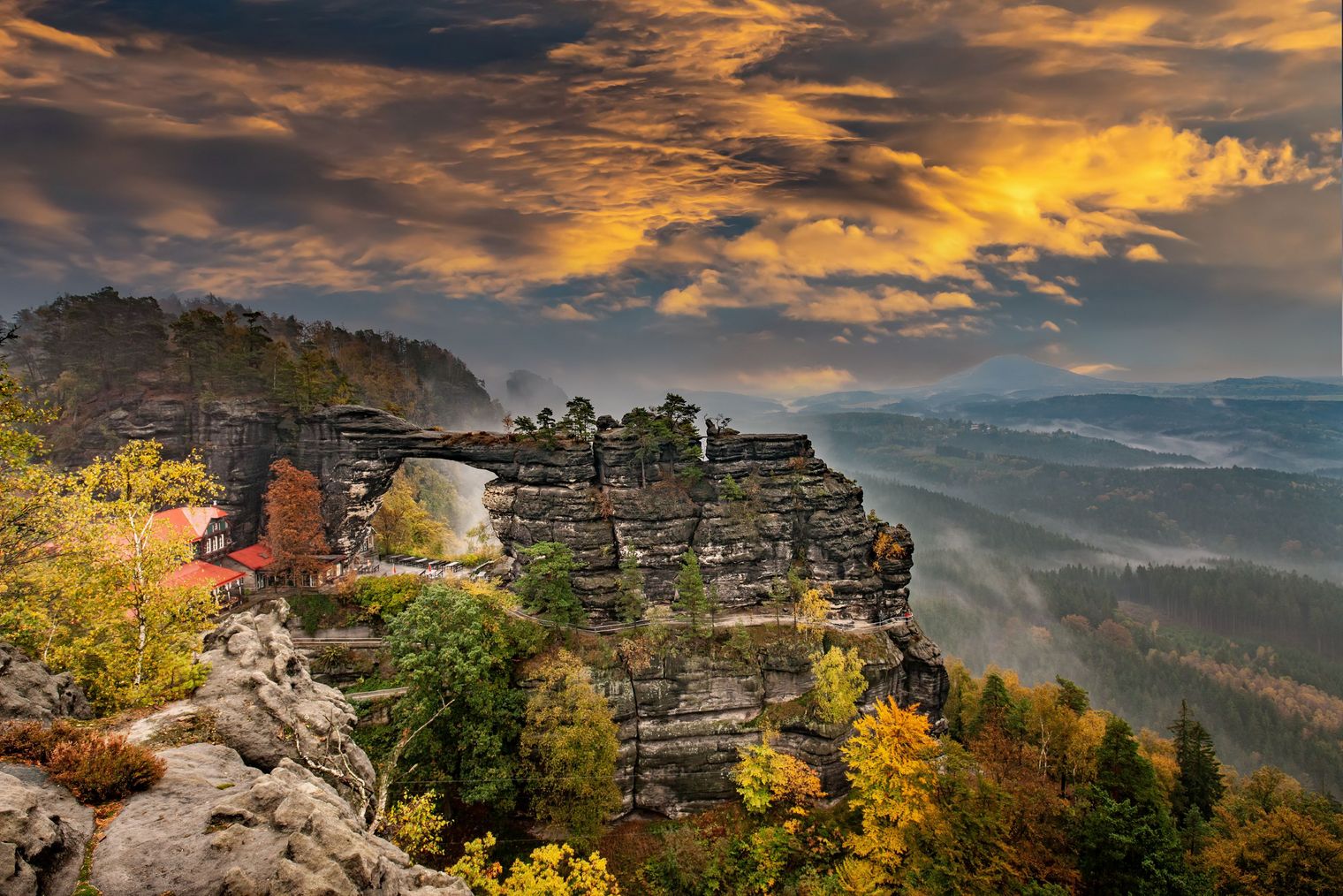
Blick auf ein Felsentor mit buntem Herbstlaub und dramatischem Himmel.
© vaclav /415999456 / stock.adobe.com

The Malerweg and the Bohemian Switzerland

The current Painter's Path largely follows its historical route. However, in the past, the route extended beyond state borders: Painters and early travelers took the old Foreigners' Path from Saxon Switzerland over the Kleine and Große Winterberg to the Prebischtor (Pravčická brána) in Bohemian Switzerland and then descended to Herrnskretschen (Hřensko). From there, they returned by boat down the Elbe River.

Today, between the Große Winterberg and the Prebischtor lies the core zone of the Saxon and Bohemian Switzerland National Parks, a sensitive and protected nature reserve. Since the completion of the 5th stage in 2026, it has been possible once again to undertake a day tour to the Prebischtor via the newly established cross-border hiking trail between Schmilka and Herrnskretschen (Hřensko). Thus, the historical Painter's Path is revived.

Tip: It's best to book 2 nights in Schmilka to hike the historical Painter's Path to the Prebischtor.

Aussicht Gohrisch zum Pfaffenstein Winter Schnee
© Yvonne Brückner

The Painter's Path in Winter

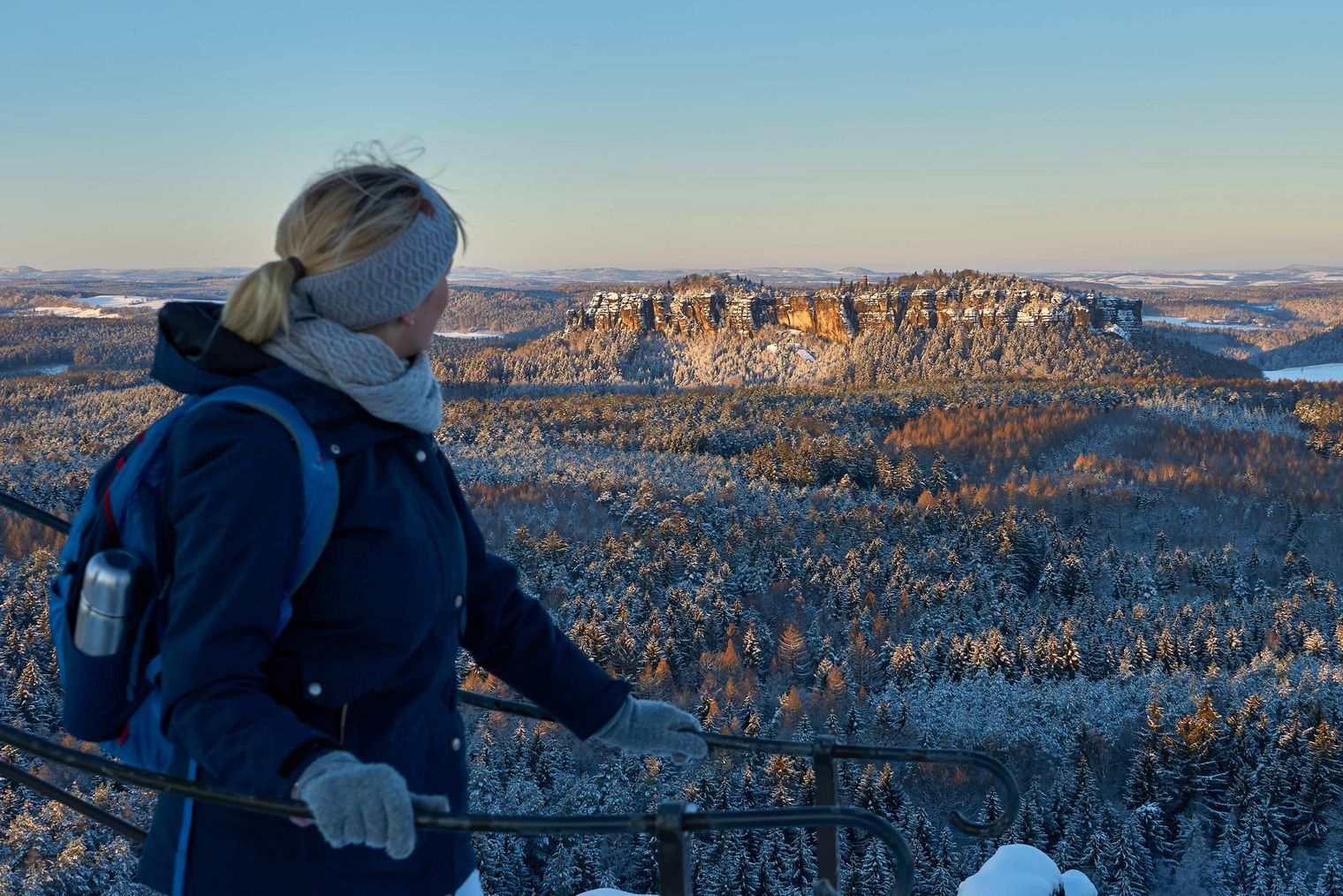
Whether the Malerweg is passable in winter depends on the weather conditions. The highest mountain on the Malerweg is called Großer Winterberg. Even though the name might suggest otherwise, at 556 meters high, there is not necessarily snow guaranteed in winter. As a general rule: if there is snow across Germany, then there will be snow on the Malerweg as well.

Basically, all hiking trails in Saxon Switzerland are accessible year-round. Caution is advised with heavy snow, snowdrifts, and black ice. The Aktivzentrum Bad Schandau sells crampons (anti-slip spikes), hiking boots, backpacks, and other equipment. Perfect for starting a Malerweg adventure in winter.

Is the Malerweg too challenging in winter? Then we recommend the 20 most beautiful winter walks on the Malerweg. These are delightful short tours along the Malerweg route. With lengths of about 2-7 kilometers and walking times of a maximum of 2:45 hours, the walks lead directly to the highlights of the individual Malerweg stages.

Wegweiser mit drei Pfeilen.
© Sebastian Thiel

Pioneering in volunteering: with heart, hand, and foresight

The Saxon Switzerland owes its special charm not only to the impressive rocky landscape but also to the people who passionately take care of its paths: the local and district path wardens. They are the unsung heroes in the background. Voluntarily, with trained eyes and a great sense of responsibility, they ensure that hiking trails are maintained and remain safe to traverse.

Especially the Malerweg could not be signposted in this quality outside of the national park without their active support. Whether in wind, rain, or sunshine – they ensure that the trail signs remain clearly visible and orientation is never lost. Their dedication connects all hikers with the landscape – and deserves our utmost respect and heartfelt thanks.

A hiking sign is damaged or missing? Markings have faded or trees have been freshly felled and no marking is visible anymore? It is best to report this via email.

Accessible Tours, Artists on the Painter's Path, Offers and Events