Planning

Hiking Bliss on the Painters' Way

The Painters' Way is one of Germany's most beautiful hiking trails. Over 116 kilometres, it leads through the impressive rock and forest landscapes of Saxon Switzerland and is well-marked throughout.

Its name, or the "M", reliably marks the way. Additionally, signposts with time indications at important points help in assessing the next stage goals and walking times well. Thus, the Painters' Way can be experienced in a relaxed and safe manner.

REQUIREMENTS

You don't need special equipment or skills to go hiking. That's the beauty of it. However, there are a few basic rules to observe on the Painter's Way trail.

Prepare for steep sections

The Elbe Sandstone Mountains are unlike other low mountain ranges or the Alps. What is fascinating is its diverse landscape forms within a small area. However, for hikers, this often means many vertical meters over a short distance.

Parts of the Painter's Path run over stairs and ladders. This particularly requires a head for heights and sure-footedness in the Schrammstein area. Furthermore, the pronounced elevation profile results in longer walking times than in level terrain.

Since some sections of the hiking trail are very narrow or steep, it is recommended to hike the stages of the Painter's Path only with a daypack and to have the large luggage transferred to the next accommodation or to choose just one base accommodation.

How difficult is the Malerweg? 

Indications of the difficulty level help to assess the demands of the route.

Eight daily stages: This is the official recommendation for dividing the Painter's Way. The stages are designed so that a hiker with average fitness can complete them while having enough time for side trips, photos, and breaks. The individual segments range from eleven to eighteen kilometers. That might not sound like much, but the region is rich in elevation, which requires additional time and energy.

  • Stage 1 - Difficulty: easy to moderate 

    Gentle start
    Routes classified as "easy" are perfect for families with children, small groups, and hiking beginners. The paths are not necessarily barrier-free but are very comfortable. There are only a few elevation changes and at most gentle inclines, possibly a few steps. Casual shoes suffice.

  • Stages 2, 3, and 8 - Difficulty: Intermediate

    Active Recovery
    Routes in the "intermediate" category are manageable for everyone who hikes at least occasionally. Surefootedness and average physical condition are sufficient. However, paths can also become narrow and rocky. There may be ladders, stairs, and more challenging passages. Therefore, hiking boots and a backpack are recommended.

  • Stages 4, 5, 6, and 7 - Difficulty: challenging

    Athletic Experience
    On routes categorized as "challenging," experienced hikers will find their trek rewarding. Good physical condition, sure-footedness, and a head for heights are prerequisites. The tours can be long, with some sections narrow and steep. Expect significant altitude differences over short distances and larger natural rock steps. Walkability depends on weather conditions. Hiking boots, a backpack, and possibly hiking poles are recommended equipment. No securing is necessary.

Can the Painter's Way be completed in less than 8 stages?

Those who prefer a more athletic approach can also tighten the schedule. The following variations are conceivable:

  • Athletic: the Painter's Way in 7 days
    Stage destinations: Rathewalde – Altendorf – Neumannmühle – Schmilka – Gohrisch – Weißig – Pirna

  • Ambitious: the Painter's Way in 6 days
    Stage destinations: Kurort Rathen – Altendorf – Räumichtmühle – Reinhardtsdorf-Schöna – Königstein – Pirna

  • Challenge: The Artist's Trail in 5 Days
    Stage goals: Hohnstein–Lichtenhainer Waterfall –Reinhardtsdorf-Schöna –Königstein – Pirna

  • Trail Runner: Of course, it can be a lot faster, but that's no longer about hiking.

TRAVEL TIME

Whether in the mild April sun or on a clear January day: The Painter's Path in the Elbe Sandstone Mountains is always an experience – and almost always accessible.

Which season is best suited for the Painter's Trail?

The Elbe Sandstone Mountains and its most beautiful hiking trail enchant in every season. In spring, the fresh green and the blooming woodland flowers are inviting. In summer, the valleys and gorges, which the Artist's Trail traverses, become refreshing oases. Autumn brings golden light and the magic of foliage coloration. And in winter, heavenly tranquility prevails here.

With appropriate clothing, it is nearly always hiking weather. Only in cases of heavy snow, icy roads, or after a strong storm should you postpone the hiking pleasure. In any case, preparation includes a look at the weather forecast.

Painter's Trail in winter

A person in a blue jacket stands on a snow-covered rock, looking out over a wintry landscape.
View from Gohrisch towards Pfaffenstein

Whether the Malerweg is accessible in winter depends on the weather conditions. The highest mountain on the Malerweg is called Großer Winterberg. Even though the name suggests otherwise, at 556 meters in height, there is no guarantee of snow in winter. As a rule of thumb: if there is widespread snow in Germany, then it will also be on the Malerweg.

In general, all hiking trails in Saxon Switzerland are accessible year-round. Caution is advised in deep snow, snowdrifts, and icy conditions. The Activity Center Bad Schandau sells crampons (anti-slip spikes), hiking boots, backpacks, and other equipment.

Tip: For the 20th anniversary of the Malerweg, there is, for the first time, a collection of the most beautiful short tours along the route. Ranging from about 2 to 7 kilometers in length and with walking times of up to 2:45 hours, the walks lead directly to the highlights of the individual day stages.

Hiker-friendly Hosts and Inns

From campsites to five-star hotels, there are numerous accommodations along the Malerweg in the Elbe Sandstone Mountains to suit every category. Many of them have specifically catered to Malerweg hikers and offer, among other things, one-night stays, packed lunches, and luggage transfer.

Wooden bed frame next to a bedside table with a black table lamp in front of a red patterned wall.
Schmilka Mühle Room

Reserve in advance? With a fixed or varying accommodation?

Particularly during extended weekends, on holidays, and in vacation periods, it is challenging to find accommodation for just one night. This is the absolute peak season in Saxon Switzerland. Likewise, the months of May to October are extremely busy. Here we strongly recommend making a reservation in advance! From November to Easter, you have a good chance of booking accommodation even at short notice, but the capacities are sometimes limited, and some accommodations close for the winter. Therefore, you should check in advance whether the desired accommodation at the stage destination is open. As an alternative, we recommend year-round accommodation in a central location.

The tourism association Saxon Switzerland offers a free information and booking service. Phone: +49 3501 470147

Inns along the Painter's Path

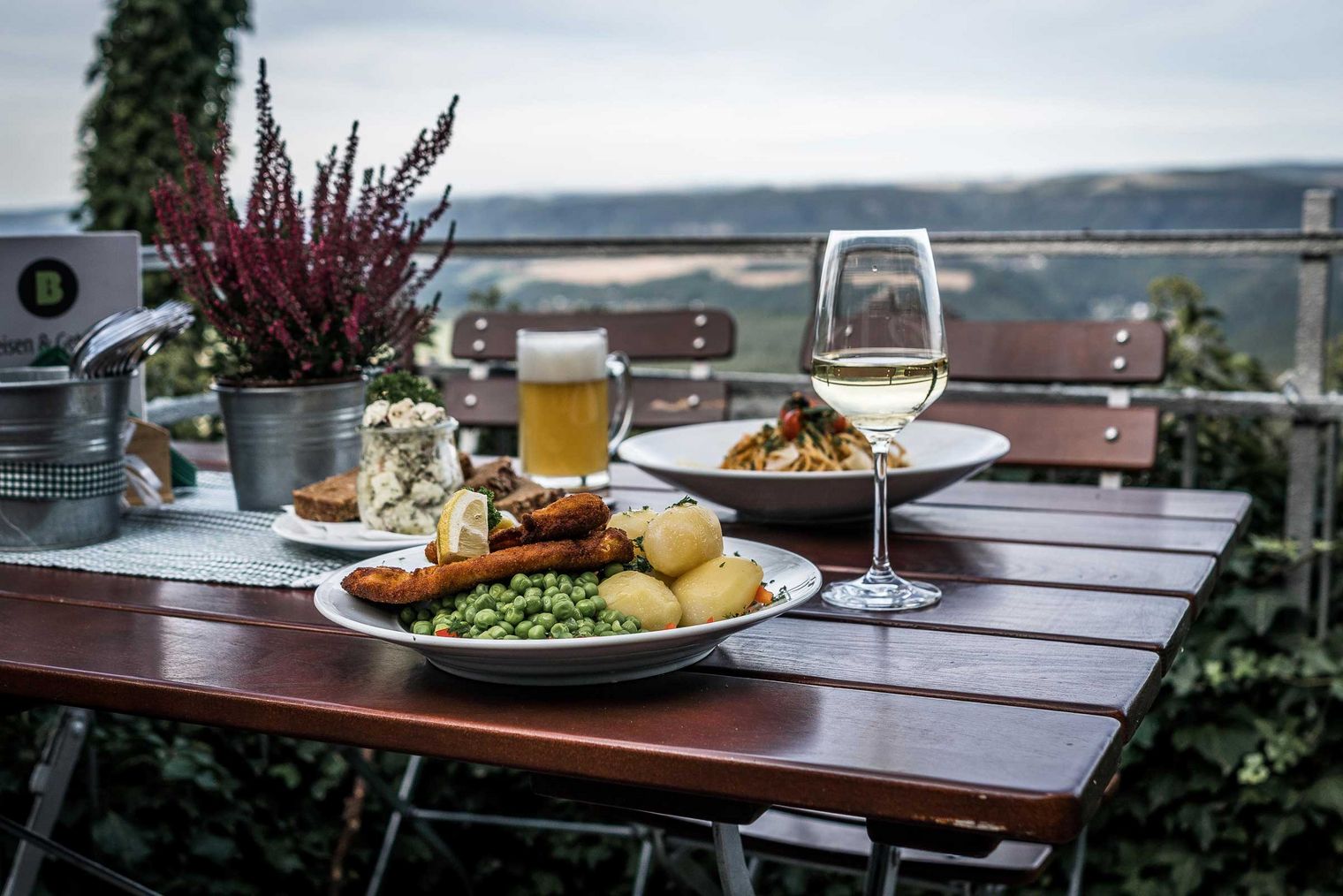
Stunning views of table mountains, dense forests, quiet valleys, and charming villages make the Painter's Path a unique experience. At many of these beautiful spots, it's worth taking a leisurely break — enjoying regional specialties, a good glass of wine, or a cup of coffee. To match this, traditional rest stops along the way invite you to linger. Hikers can also obtain the stage stamp and the collection postcard for each stage for their hiking pass there.

Two plates of food, a glass of beer and a glass of wine on a wooden table with a view.
Papststein Mountain Inn

Arrival

Saxon Switzerland begins a few kilometers southwest of the Saxon state capital Dresden and extends on both sides of the Elbe to the border with the Czech Republic.

Train or car? Comfort is what matters.

These are the most popular options:

  1. take an IC, ICE, RE or long-distance coach to Dresden and then continue by suburban train to the heart of the region
  2. take the EuroCity (EC) or the European Sleeper (night train) directly to Bad Schandau National Park railway station, or
  3. travel by car or motorcycle via the A17 to Pirna.

Where can you park your car along the Malerweg?

Parking along the Malerweg? No problem. Long-stay parking is available for visitors who wish to change accommodation at each stage. 

Orientation en route

The Saxon Switzerland is easy to hike! The forest and rock-rich national park region is crisscrossed by a network of well-marked paths. The Malerweg is no exception.

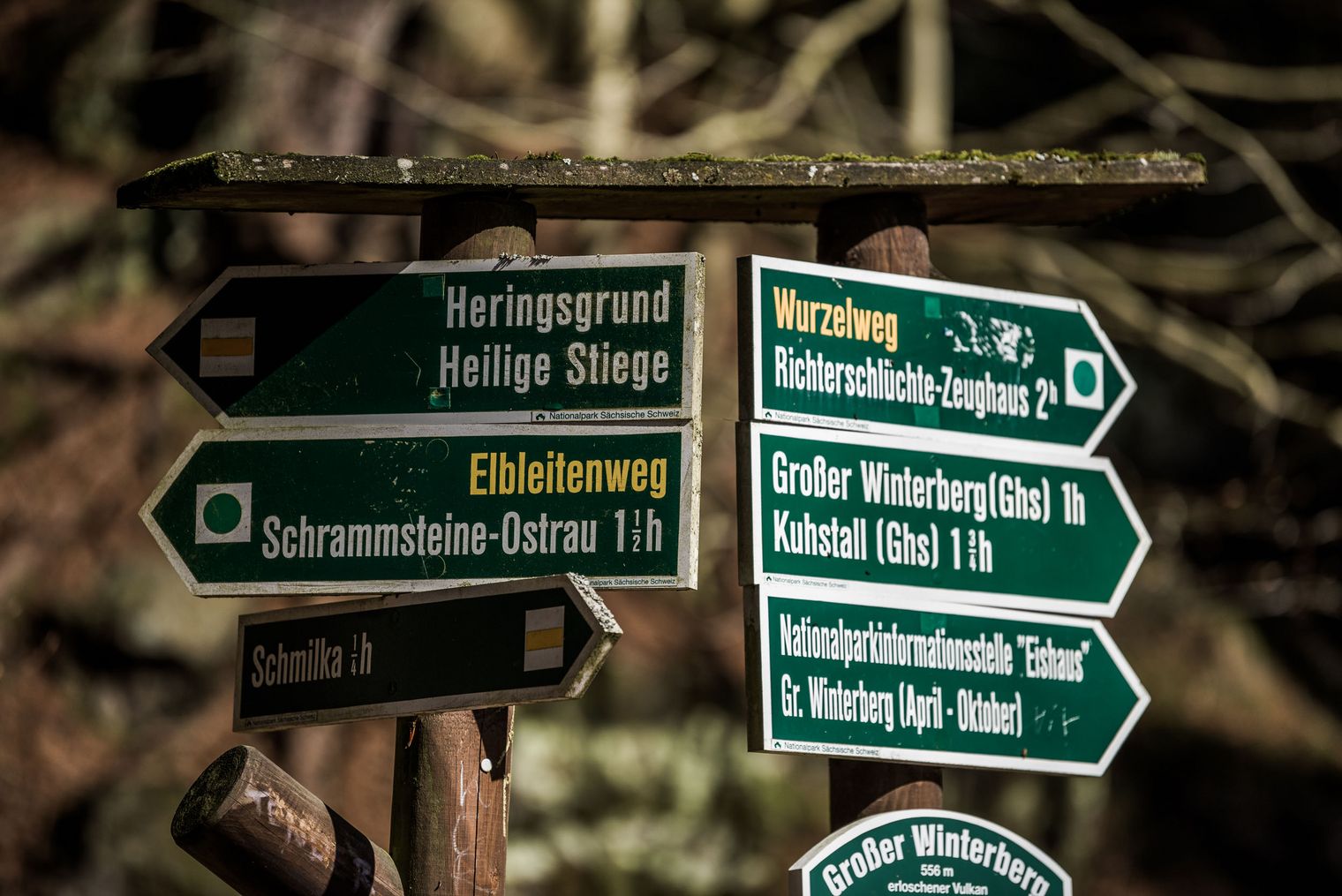
Signpost showing various routes and distances in a forest.
Hiking Signs in Saxon Switzerland

A brief guide to trail signs along the Malerweg

The curved black M on a white background guides hikers along the route. It is useful to know the region’s most important trail signs. The signposts feature abbreviations such as AP for viewpoint, Ghs for inn or E3 for the European long-distance path, which also passes through Saxon Switzerland. 

Small yellow signs bearing location numbers on the front or back of the posts help emergency services find hikers more quickly in an emergency. The coloured trail markers are also important: a green arrow, for example, indicates more challenging mountain trails that require sure-footedness and a head for heights. Black arrows on a white background, by contrast, do not mark hiking trails; they indicate approaches to climbing crags and are not part of the regular Malerweg route.

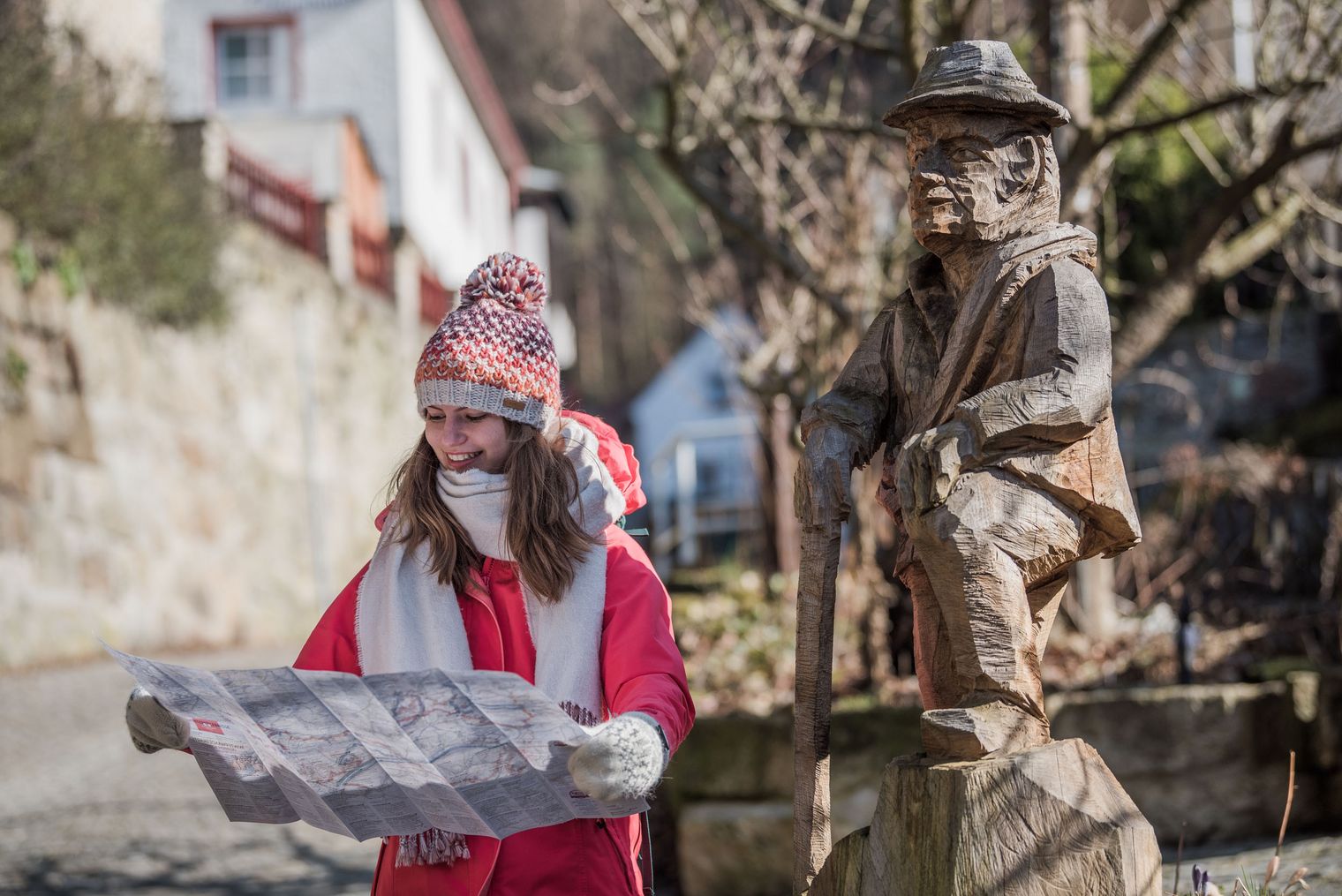
Woman in a red coat and scarf holding a hiking map in front of a wooden sculpture of a man.
Hiking with a hiking map

GPX Track or Map?

Even though the signage on the Malerweg is very good, it is advisable to use a paper map or an offline accessible hiking app for additional orientation. Due to the rocky landscape and occasionally limited network coverage, you cannot always rely on GPS reception. Therefore, GPX tracks or maps should be saved on the smartphone before each stage hike. For navigation on the Malerweg, specialized hiking apps are better suited than classic car navigation. Google Maps is not recommended for hiking on the Malerweg.

Worth knowing

Is the route suitable for a hiking vacation with kids and family? What else should be considered?

For clarity, we have compiled and answered all frequently asked questions in an overview.

Rest Days

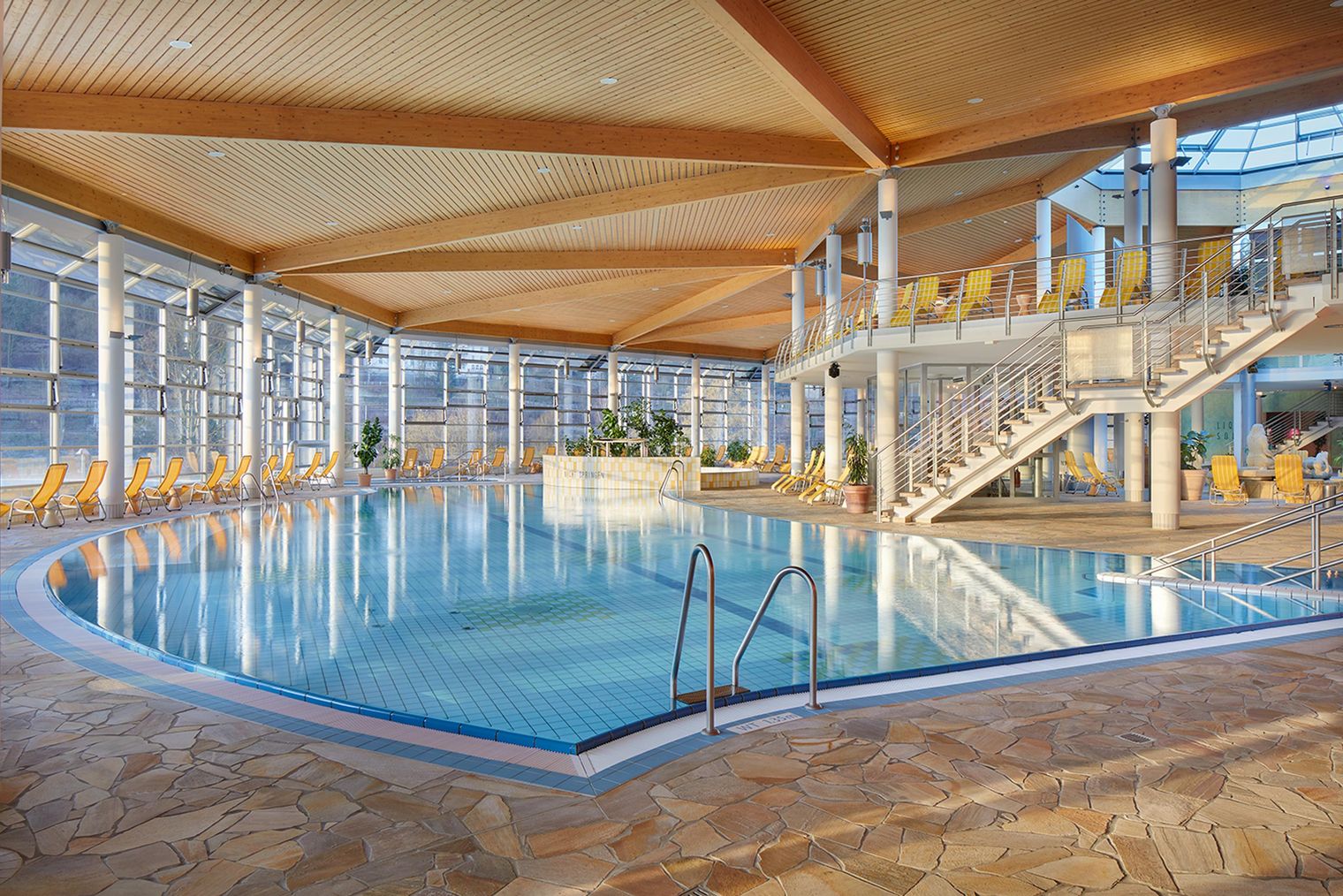
A hiking holiday doesn't mean covering distance every day – quite the opposite. Rest days are explicitly allowed and make a valuable contribution to relaxation. Sleeping in, enjoying wellness activities, discovering culture, eating well, reading, or simply letting your mind wander: All of this is part of a successful break in Saxon Switzerland. 

Indoor area of Toskana Therme Bad Schandau with a large pool
Toskana Therme Bad Schandau

Landscape and Animals

The Saxon Switzerland is among the most impressive natural landscapes in Germany. Along the Malerweg trail, the landscape is characterized by striking sandstone formations, deeply cut valleys, and expansive forests. Bizarrely shaped cliffs and free-standing table mountains continuously offer spectacular views over the Elbe Sandstone region.

The wildlife is also remarkably diverse. In the expansive forests, red deer, wild boar, and foxes, among others, can be found, while in the rocky regions, rare species like the peregrine falcon and the eagle owl find ideal breeding places. The combination of pristine nature, impressive geology, and a rich variety of wildlife makes every stage of the Malerweg trail an intense nature experience.

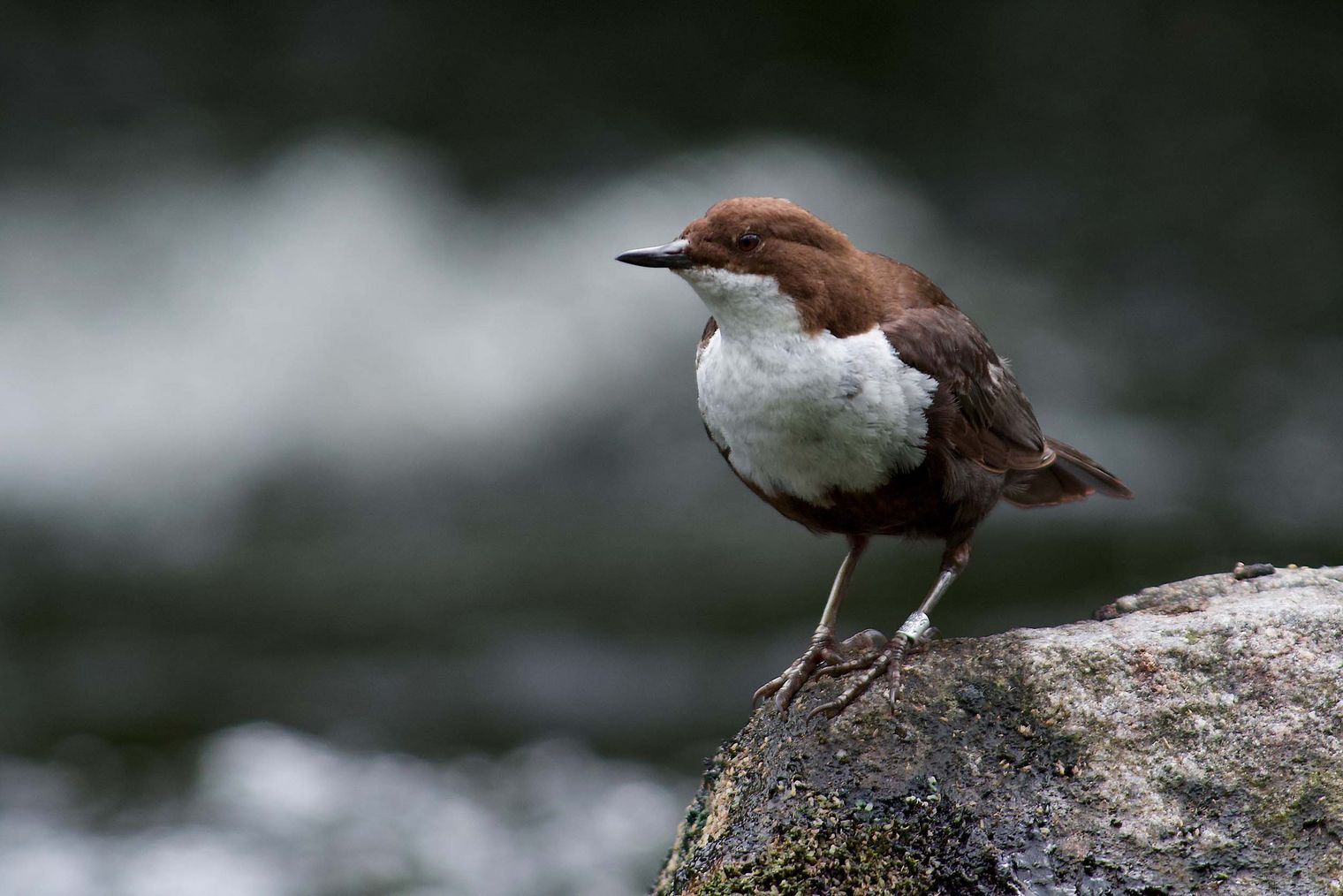
A brown bird with a white breast, a white-throated dipper, sits on a rock by the water.
White-throated dipper

Painter's Trail with children

For children, the Malerweg is the finest adventure land. Here, there are mystical forests, murmuring streams, mysterious caves, peculiar rocks, and much more to stimulate the imagination and satisfy the urge to move. However, the many ladders and steps do add up to a considerable altitude difference. Additionally, one should always keep in mind that not every slope or viewpoint has a railing.

Everyone knows their offspring best. The daily stages of the Malerweg hiking trail are certainly manageable with children aged about 10 and above.

With smaller children, you might prefer to opt for one of the shorter circular hiking trails, like this one:

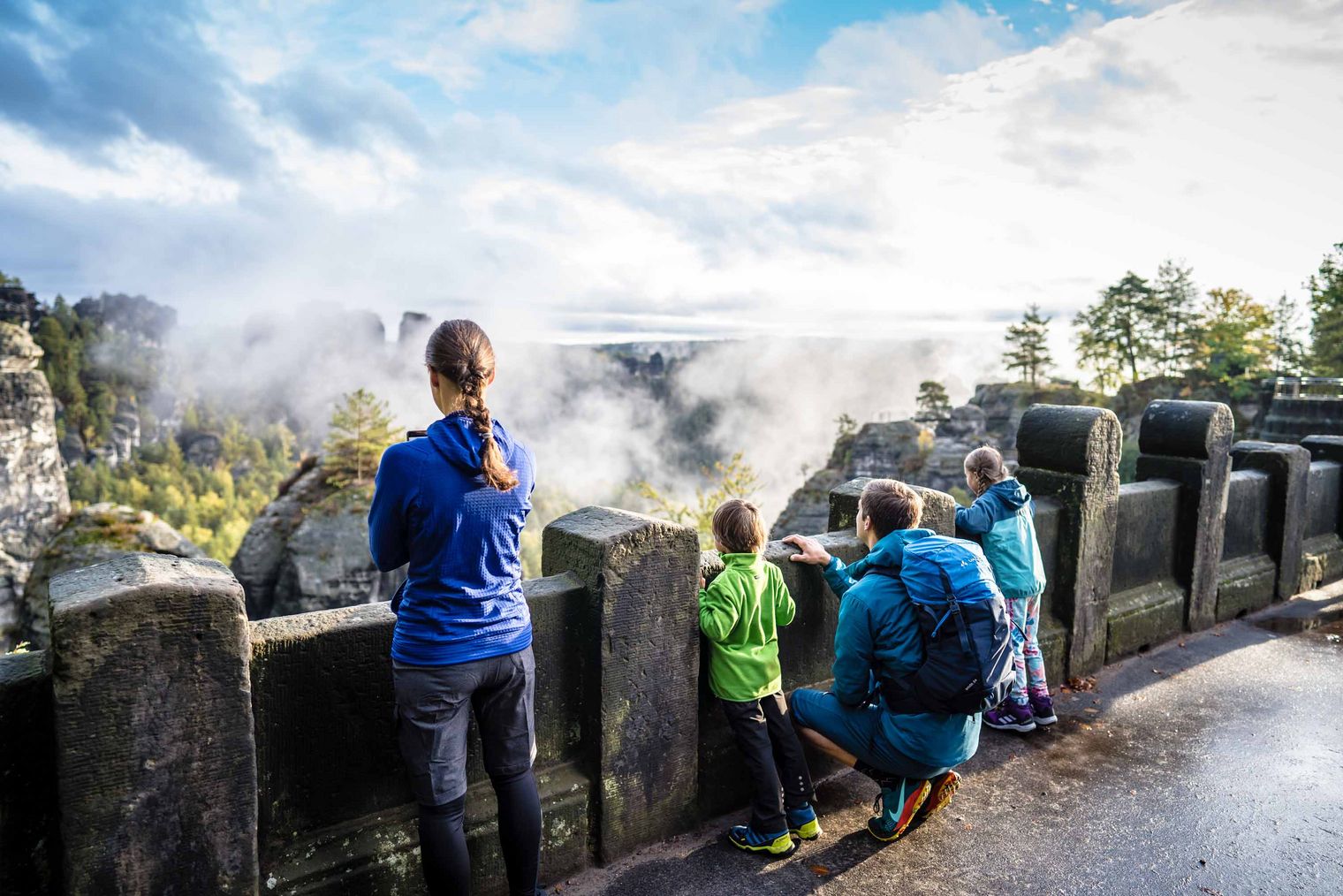
A family stands on the Bastei Bridge, looking out over a misty landscape.
Family on the Bastei Bridge

Painter's Trail with a dog

With a dog in Saxon Switzerland? Certainly. Hiking over warm rocks, through soft sand, over gnarled roots and cool forest paths is pure joy for paws.

However, it should be noted that numerous paths lead over steps and ladders. For four-legged friends, these are often insurmountable obstacles. While small dogs can be carried, owners of larger animals should bypass these spots. Recommended alternatives to circumvent difficult sections on the Painter's Way can be found linked here.

Please note: Leash laws apply in the national park, and muzzle requirements in public transport. Do not forget a water bowl and water!

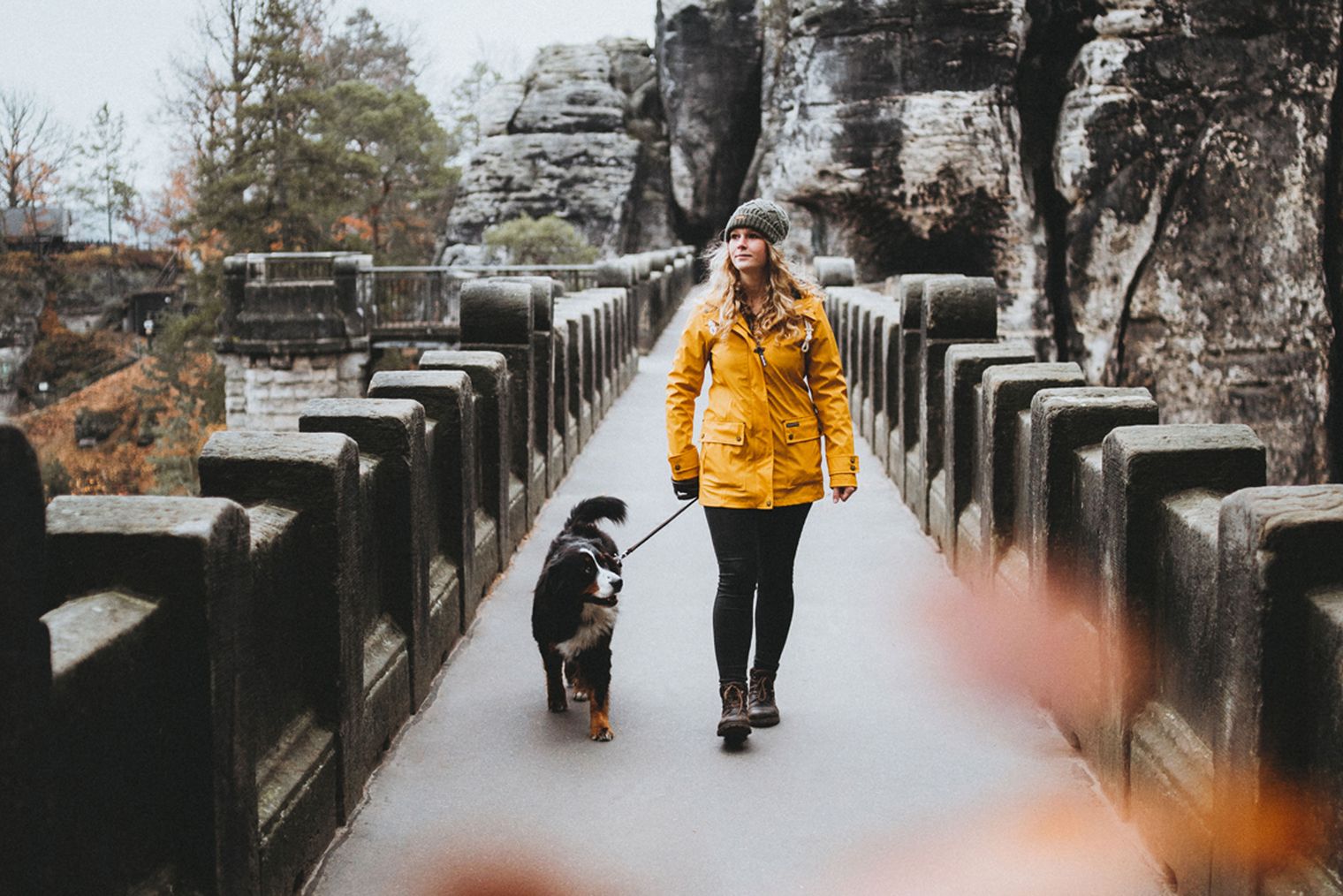
Woman in a yellow jacket walking a dog on a bridge between rock formations.
Malerweg Trail with a Dog

Information on the individual stages

Stage 1 (11.5 km / 4 hrs)

From Liebethal (Pirna) to Stadt Wehlen
This stage of the Malerweg should be manageable with a dog without difficulty.

Stage 2 (13.8 km / 5.5 hrs)

From Stadt Wehlen to Hohnstein
Bypass the Wolfsschlucht gorge via the Hohnstein educational trail.

 The forest is closed in the area around Amselgrund and in the Schindergraben near Hohnstein. Please use these directions as a diversion: malerweg.link/Umleitung-Etappe-2

Stage 3 (14 km / 5.5 hrs)

From Hohnstein to Altendorf
This stage of the Malerweg can also be completed with a dog without difficulty.

Stage 4 (19 km / 7.5 hrs)

From Altendorf to Neumannmühle
From Altendorf, descend through the Dorfbachklamm gorge (note: diversion) and take the turning on the left. This provides a convenient hiking route to Ostrauer Mühle. The Malerweg leads uphill via the Mühlweg and Bauweg trails to the Elbleitenweg trail in the Schrammsteine. The ascent via the Jägersteig trail can be bypassed by following the Elbleitenweg and Zeughausweg trails. The stage ends at the Lichtenhain Waterfall, where there is a connection to the Kirnitzschtal tramway.

Stage 5 (13.6 km / 7 hrs)

From Neumannmühle to Schmilka
Hiking with a dog is possible on this stage.

Stage 6 (17.6 km / 7 hrs)

From Schmilka to the spa resort of Gohrisch
On stage 6, the only difficulties for four-legged companions are on the Gohrischstein. To avoid the iron ladders, it is advisable to bypass the Gohrisch, which is possible in both directions.

Stage 7 (17.3 km / 6.5 hours)

From the spa resort of Gohrisch to Weißig
From the spa resort of Gohrisch, the Muselweg, Jagdsteig, Königsweg and Alter Schulweg trails lead keen hikers to Pfaffendorf. To climb the Pfaffenstein, an alternative to the "Nadelöhr" ascent should be chosen at this point. Upon reaching the Pfaffenstein, owners and their dogs are rewarded with a view of the legendary Barbarine, a landmark of Saxon Switzerland.

The descent towards the Quirl can be made via the Klammweg trail. On the north-eastern side of the Quirl is a large accessible cave known as the Diebeshöhle, which is well worth exploring. The nearby Latzweg trail leads to the foot of Königstein Fortress, which is also worth visiting with a dog, although a little more time should then be allowed. The route continues along the old fortress road and the Kanonenweg trail via Thürmsdorf to Weißig, where bus route 243 (Pirna–Königstein) can be taken.

Stage 8 (13.6 km / 5 hrs)

From Weißig to Pirna
On the final stage of the Painters’ Way, the Rauenstein massif can be bypassed via the forest track. The route then leads to Wehlen-Pötzscha and Naundorf. In the centre of Naundorf, the Painters’ Way leads across former quarries to the Königsnase and continues to Obervogelgesang. The S-Bahn can be boarded here. From there, follow the Elbe Cycle Route towards Pirna, then turn right onto the Canaletto Trail, which leads into Pirna’s town centre.

More walks with dogs

Beyond the Malerweg, the Elbe Sandstone Mountains also offer dogs and their owners countless opportunities to enjoy extensive walks and experience the breathtaking landscape.