© Sebastian Rose

Caspar David Friedrich

in Saxon Switzerland

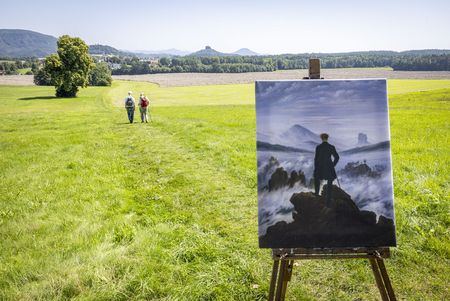
It is probably the best-known painting of German Romanticism: "Wanderer above the Sea of Fog". It was created around 1818 by Caspar David Friedrich (1774-1840). Fairytale-like, mysterious, and alive - this is how the landscape presents itself to the viewer. The painting is famous not only for its aesthetic qualities, but because it is a symbol for the spirit of Romanticism. The landscape shown in the painting is Saxon Switzerland. For Friedrich, who spent most of his life in Dresden, the nearby rocky world was a place of longing and inspiration.

Germany's Most Beautiful Hiking Trail 2025

Zwei Personen gehen auf einem Feld, im Vordergrund steht ein Gemälde auf einer Staffelei.
© Marko Förster

The Caspar David Friedrich Trail between Krippen and Schöna was voted "Germany's Most Beautiful Hiking Trail 2025" in the category of day tours in the nationwide audience competition held by Wandermagazin. This brings the prestigious title back to Saxony after 18 years – the last winner was the Malerweg Elbe Sandstone Mountains in 2007. The approximately 15-kilometer route was comprehensively redesigned last year to mark the 250th anniversary of Caspar David Friedrich's birth: new information boards, optimized routing, and impressive viewpoints invite visitors to explore the landscape that inspired the world-famous painter to create his most famous works.

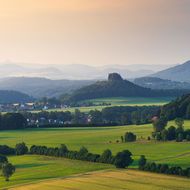
Weite Landschaft mit sanften Hügeln, Feldern und einem markanten Felsen im Hintergrund.
© Philipp Zieger
"The only true source of art is our heart, the language of a pure childlike mind. A creation not originating from this wellspring can only be artifice."
Caspar David Friedrich

The 10 most beautiful places on the trail of Caspar David Friedrich

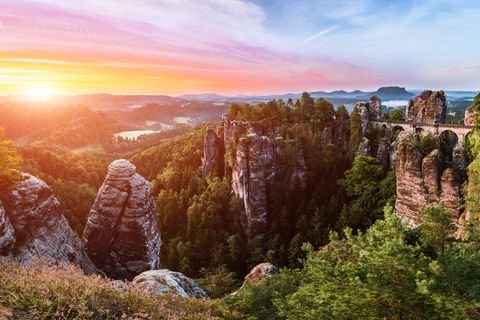
Sonnenaufgang über einer felsigen Landschaft mit Bäumen und einem weiten Blick auf das Tal.
© Kenny Scholz

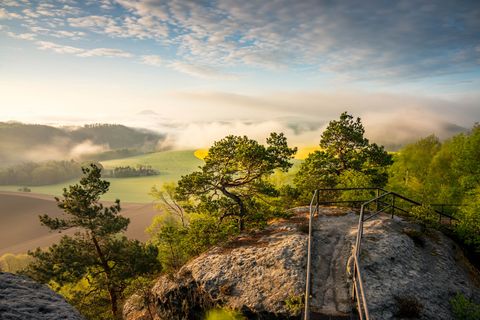
Bastei

With its particularly impressive landscape, the Bastei area has always offered a wealth of motifs for artists. Caspar David Friedrich also immortalized it in some of his works. The oil painting "Felsenlandschaft" (Rocky Landscape) from 1823, for example, depicts the imposing rock formation of the Neurathen Rock Gate.

Learn more
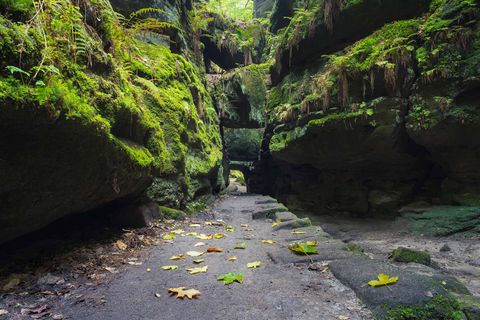
Schmale Schlucht mit grünen Wänden aus Pflanzen und einem kieseligen Boden.
© Philipp Zieger

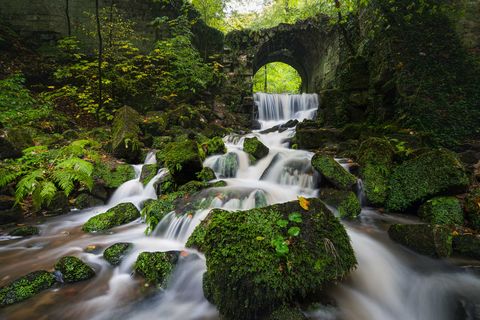
Uttewalde Rock Gate

Depictions of the Uttewalder Felsentor marked a turning point in the perception of the landscape at the end of the 18th century: horror at the primal force and threat of nature turned into delight at the picturesque romance of becoming and passing away. Caspar David Friedrich sought solitude in the area for several days and sketched the landscape. He reported to the Russian poet V. A. Zhukovsky in 1821 that he had once lived for a whole week in the Uttewalder Grund "between rocks and fir trees" and had not met a single soul. In 1825, he processed this intensive experience into his gloomy oil painting "Uttewalder Grund".

Learn more
Vollmond über einer Stadt mit historischen Gebäuden und einer Burg im Hintergrund.
© Philipp Zieger

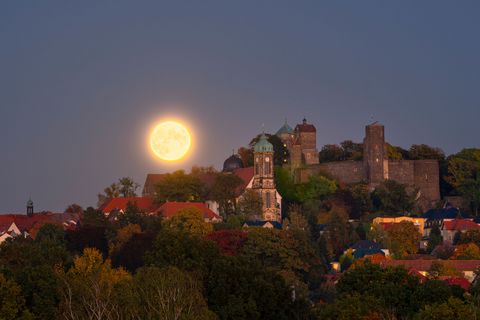
Stolpen Castle

The old Stolpen Fortress, with its silhouette visible from afar, also aroused the interest of the Romantics. Caspar David Friedrich stayed in Stolpen on August 27, 1820, and drew the freestanding, towering Cosel Tower in portrait format. "The towers too long," Friedrich noted on his sketch of the Cosel Tower that day. Next to the tower, a gaping wound. Here he drew the part of the complex that had been destroyed by Napoleon and his troops just a few years earlier. The gap in the wall and the rubble that was blasted out of it can be clearly seen. At that time, Friedrich made it his task to document the traces of Napoleonic destruction and drew them wherever he could.

Learn more
Blick auf eine bewaldete Landschaft mit Felsen und Nebel über den Feldern im Hintergrund.
© Britta Prema Hirschburger

Kaiserkrone

Caspar David Friedrich worked on the famous "Wanderer above the Sea of Fog" around 1817. For the figure seen from behind, he needed a prominent rock on which to position the wanderer. He used a rock on the ascent to the Kaiserkrone as a model for this. He must have discovered this rock during one of his hikes in Krippen in 1813. "So high above the highest point of the stone is the horizon," he noted on the edge of the drawing "Rocky Knoll". Five years later, this sketch served as a template for his famous painting. Even though the rock is located at the foot of the Kaiserkrone, an ascent to the Kaiserkrone is worthwhile. The view is phenomenal!

Learn more
Ein kleiner Wasserfall fließt über moosbedeckte Steine unter einem alten Steinbogen. Grüne Pflanzen umgeben die Szene.
© Philipp Zieger

Hohnstein

The year 1800 can be considered the peak of Friedrich's Saxon Switzerland euphoria. The then 25-year-old was in the region at least five times that year. In addition to his multi-day adventure in the Uttewalder Grund, Friedrich visited the area around Hohnstein at the beginning of July. Already due to its location, Hohnstein Castle offers a picturesque sight. The immediate surroundings of the rocks and deeply incised valleys practically attracted painters in the 18th and 19th centuries. As it did Caspar David Friedrich! At the beginning of July 1800, Friedrich stayed at Hohnstein, where he sketched the gateway to Hohnstein Castle on July 8 and the so-called "Schinderloch", an opening of the Bärengarten in Hohnstein that still exists today, on the following day. Friedrich was impressed by its ruins and captured the complex in a pencil sketch.

Learn more
Ein kleiner Wasserfall fließt über moosbedeckte Steine unter einem alten Steinbogen. Grüne Pflanzen umgeben die Szene.
© Philipp Zieger

Polenztal

Also around 1800, Friedrich roamed through the lovely Polenztal valley and discovered the imposing, pine-covered sandstone block. Years later, he incorporated the rock study into his painting "View into the Elbe Valley" (Ausblick ins Elbtal). Taking artistic liberty, he lifted the multi-ton colossus onto a viewpoint and replaced the pines with spruces.

Learn more
Blick auf einen Fluss mit Nebel, im Hintergrund ein markanter Berg und eine bewaldete Landschaft.
© Anna Meurer

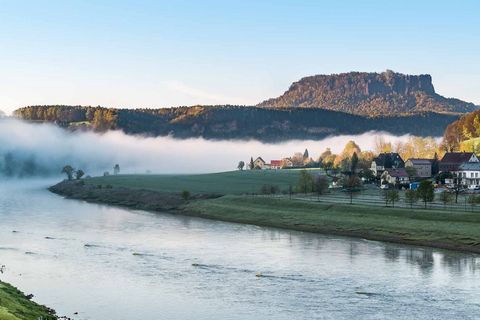
Lilienstein

A flat plateau, almost vertical rock faces, a wooded base, open countryside all around. The 415-meter-high Lilienstein is a striking phenomenon. Caspar David Friedrich was also fascinated and drew the only table mountain on the right bank of the Elbe from various perspectives. Views from Rathen, Krippen, and Prossen have been handed down. Whether he was ever on the plateau of the Lilienstein cannot be said with certainty. In a sepia drawing around 1836, the Lilienstein makes a final grand appearance in Friedrich's work – as the otherworldly destination of an arduous life journey.

Learn more
Zwei Personen gehen auf einem Waldweg, umgeben von Bäumen und sanftem Licht.
© Philipp Zieger

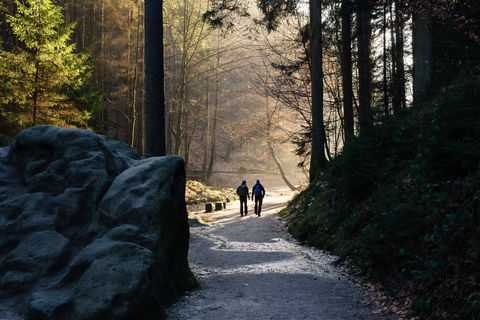
Amselgrund

Like the Gamrig, the Honigstein also somewhat resembles castle ruins. The striking formation is only hinted at in the background of Friedrich's watercolor "Rocks by a Forest Path," created around 1810, but it is crucial for the composition. The painter's location can be easily traced through the perspective. It is the path through the Amselgrund, shortly before the Amselfall. In this, as in other paintings of the time, one can see that at the beginning of the 19th century, Saxon Switzerland was significantly less densely wooded. Today, the Honigstein mostly hides behind tall trees.

Learn more
Blick aus einer Höhle auf eine Landschaft mit Bäumen und einem Berg im Hintergrund.
© parallel dream / #367068297 / stock.adobe.com

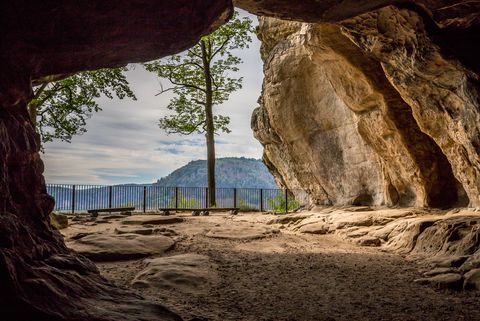
Kuhstall

Even in Caspar David Friedrich's youth, the "Kuhstall", the largest rock arch in Saxon Switzerland, was a popular excursion destination. Nature lovers had rolled a block of stone into it to use as a table, someone had chiseled a cooking area into the rock, there was a snack stand in the summer, and it was fashionable to write one's name on the rock wall. Brushes and ink were even provided for this purpose! Both are forbidden today! Friedrich was also here several times. His drawing, created around 1818, was made during a hike with his wife and his friends Kummer and Carus.

Learn more
Blick auf eine Stadt mit historischen Gebäuden und einer Burg auf einem Hügel, umgeben von Bäumen und Wolken.
© Sarah Haut

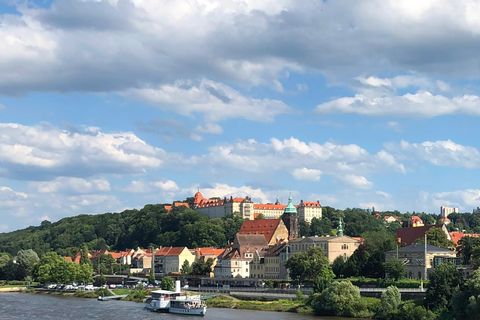
Pirna

Caspar David Friedrich repeatedly interrupted his work in his studio in Dresden to hike and sketch in Saxon Switzerland. At least 19 stays are documented. He surely often passed through the old Elbe Gate of Pirna during these trips. He sketched it during one of his very first encounters with it. The remainder of the old city fortification had already been used as a motif by Bernardo Bellotto, known as Canaletto, a few decades earlier. It was demolished in the middle of the 19th century.

Learn more

The artist Caspar David Friedrich & the time

Caspar David Friedrich was born in 1774 in Greifswald as the sixth of ten children in a family of craftsmen. After studying at the Royal Danish Academy of Fine Arts in Copenhagen, Friedrich moved to Dresden at the age of 24, which at that time was a European art mecca with its significant academy. For Friedrich, who spent most of his life in Dresden, the nearby rocky landscape of Saxon Switzerland was a place of yearning, inspiration, and refuge in a world that had gone off the rails.

These were turbulent days – politically, socially, religiously, culturally. Industrialization was rapidly changing people's living conditions, and the Enlightenment was altering their worldview. Napoleon and his troops carried the horrors of the French Revolution far into Europe. As a reaction to the new rationalism of the time, a new artistic movement emerged: Romanticism. A turn towards nature, the search for the metaphysical, introspection, and the examination of aesthetic principles: these are some of the characteristics of the new art. Dresden became an important center for this, and Caspar David Friedrich one of its most important representatives.

Porträt eines Mannes im Profil, mit feinen Linien und Schattierungen, in einem skizzenhaften Stil.
© Caspar David Friedrich, Selbstbildnis, um 1802 © Hamburger Kunsthalle, bpk, Foto: Christoph Irrgang
Sonnenstrahlen fallen durch eine enge Schlucht, umgeben von moosbedeckten Felsen und grüner Vegetation.
© Iven Eißner

Caspar David Friedrich & the Saxon Switzerland

Threatening, mysterious, and equally terrifying as attractive: This is how Friedrich often depicted Saxon Switzerland in his paintings. He had found the ideal of a romantic landscape here. The perception of nature as a source of knowledge: This remained a defining theme for the painter throughout his life. Again and again, he seeks solitude and silence, not only to see nature and landscape, but to feel them. Pausing, observing, feeling: This is what Caspar David Friedrich invites us to do.

"I must stay alone and know that I am alone to fully see and feel nature. I must surrender myself to what surrounds me, unite with my clouds and rocks, to be what I am." Friedrich wrote this in the year 1821.

Zwei Wanderer gehen auf einem Feld, im Hintergrund sind Felsen und ein blauer Himmel mit Wolken.
© Philipp Zieger

Hiking in the footsteps of Caspar David Friedrich

Even in Caspar David Friedrich's time, Dresden artists knew the most impressive valleys and gorges and the paths leading to them. Friedrich had used these paths too. Today's Malerweg Elbe Sandstone Mountains follows many of these historic routes. Hikers can discover the Uttewalder Grund, the Neurathener Felsentor, the Kuhstall, and many more of Caspar David Friedrich's motifs along the total 116-kilometer long-distance hiking trail.  

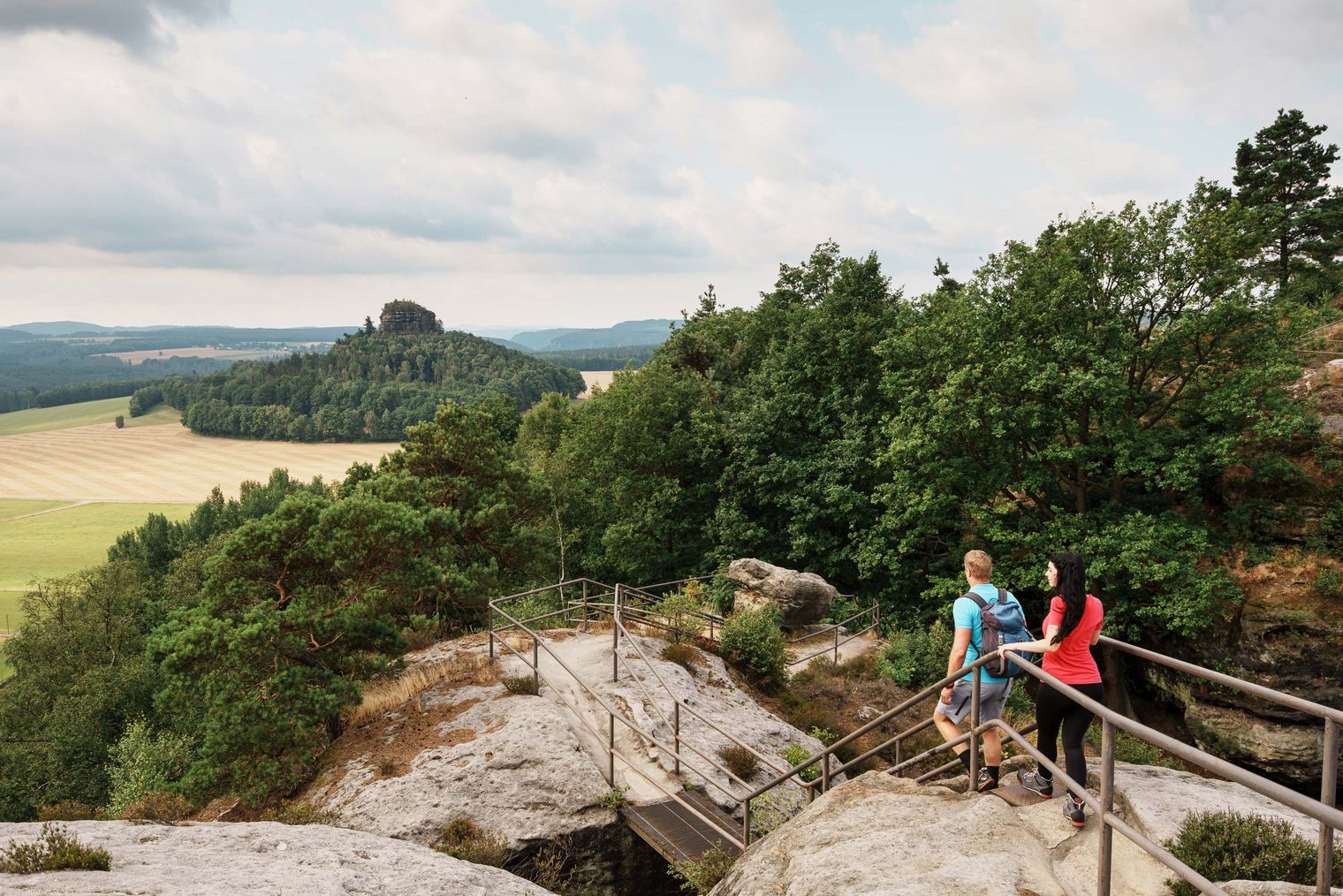
The Caspar David Friedrich Trail commemorates Friedrich's "flight to Krippen" in 1813. The hiking trail, which is about 15 kilometers long in total, leads from Krippen along the Mittelhangweg to Schöna with the Kaiserkrone, and then via the Wolfsberg and through Reinhardtsdorf back to the starting point. Based on the drawings in the "Krippen Sketchbook," it can be deduced that the artist must also have traveled along this route.

Zwei Wanderer auf einem Holzsteg mit Felsen, umgeben von Bäumen und einer weiten Landschaft.
© Philipp Zieger
Paar hält Händchen und geht eine Treppe hinunter mit Blick auf eine weite Landschaft.
© Philipp Zieger
Zwei Personen wandern durch eine felsige Landschaft mit grünen Pflanzen im Hintergrund.
© Philipp Zieger

Facts about the Caspar David Friedrich Trail

5  h

Walking time - The specified time is based on an average empirical value. If you want to pause now and then during the tour in the spirit of the Romantics and let nature take its full effect on you, then plan a little more time.

12  Information boards

along the Caspar David Friedrich Trail show the drawings by Caspar David Friedrich created at the respective locations.

15  km

Route - Highlights along the route are the Mittelhangweg, the Kaiserkrone, the panoramic view from the Wolfsberg and the Caspar David Friedrich stele in Krippen (created by stonemason Jan Lorenz)

369  m of elevation

This is a predominantly comfortable and scenically varied day tour. Climbs have to be mastered on the Mittelhangweg, Aschersteig and up to the Kaiserkrone. You will be rewarded again and again with breathtaking views!

Wanderer stehen auf einem Waldweg neben mehreren Wegweisern in grüner Umgebung.
© Philipp Zieger
Paar wandert auf einem Waldweg, umgeben von Bäumen und Farnen.
© Philipp Zieger
Person in blauer Kleidung steht auf einem Felsen, umgeben von grünen Bäumen und Sträuchern.
© Philipp Zieger
Zwei Personen sitzen auf dem Boden und schauen auf eine große, projizierte Wand mit einer künstlerischen Darstellung.
© Marko Förster

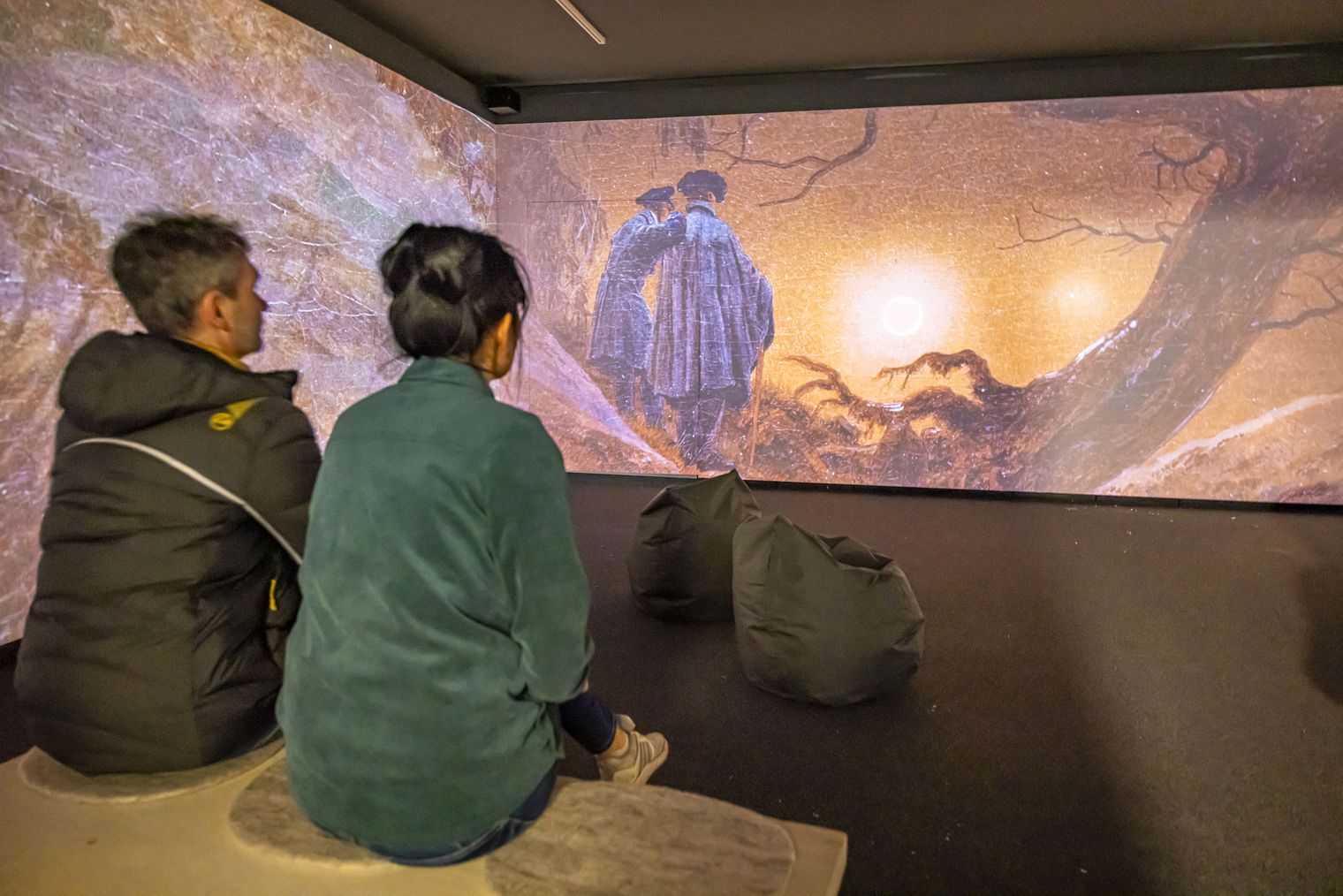
Media exhibition

“CDFriedrich inspires”

Caspar David Friedrich loved the wildly romantic rocky world not far from the city of Dresden. Time and again, he roamed through nature, sought solitude, and drew rocks, mountains, trees, and ruins. Now, for the first time in Saxon Switzerland, there is an exhibition dedicated to the famous Romantic, who would have celebrated his 250th birthday in 2024. The immersive show "CDFriedrich inspired" is both a multimedia monument and a virtual gallery. With room-filling video projections, it invites visitors to encounter the painter and his work, to see the landscape through his eyes, and to understand the creative process – from the sketch to the painting.

Zwei Wanderer auf einem Holzsteg mit Felsen, umgeben von Bäumen und einer weiten Landschaft.
© Philipp Zieger

Guided hike along the Caspar David Friedrich Trail

Off into Romanticism

With this guided tour along the Caspar David Friedrich Trail, we embark on a journey into the pictorial world of the painter. We take time to observe the nature on site, which we can rediscover as motifs in Friedrich's nature studies and paintings.

Dates: Wednesdays, 09:30 AM

Meeting point: Tourist Service Bad Schandau

Hikes and places of inspiration

in the footsteps of Caspar David Friedrich