- 5:25 h
- 15.75 km
- 541 m
- 521 m
- 121 m
- 347 m
- 226 m
- Start: Kurort Rathen
- Destination: Bad Schandau

Pavements
- Street (3%)Asphalt (17%)Gravel (15%)Trail (22%)Path (44%)
Best to visit
- suitableDepends on weather
Directions
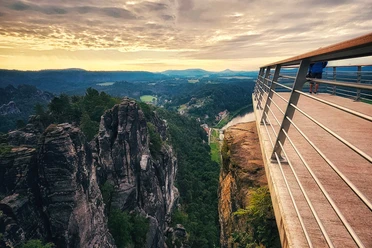
In Kurort Rathen the path leads into the Amselgrund. It passes the ascent to the Felsenbühne Rathen, the Amselsee, the Amselfall, and continues to Rathewalde. Behind the village, the path runs parallel to the road towards the Hockstein parking lot. From Hockstein, Hohnstein can already be seen on the other side of the Polenztal. You reach it by descending the steps through the narrow Wolfsschlucht, along the Polenz for a short distance, and climbing back up the wild romantic Schindergraben. After visiting Hohnstein Castle, the route first descends again into the Bärengarten. From the former animal park, only picturesque wall remains exist. The forest hiking trail then leads over the Halbenweg and the Räumichtweg towards the Brand viewpoint. The view from the Brand massif over the Polenztal is one of the most famous in the region. From the Brand, it goes down over 800 steps into the Tiefen Grund. There, for today, we leave the painter's path and follow the Lachsbach to the Elbe towards Bad Schandau.
In July 1800, Caspar David Friedrich embarked on a multi-day hike in the Saxon Switzerland region, specifically around Hohnstein. Friedrich started his route in Dresden and presumably stayed overnight in Lohmen before continuing towards Hohnstein. Along his route, he passed the Hockstein tavern and descended into the Polenztal, where he turned right at the old Polenz bridge and followed the stream. The valley became increasingly wild and inaccessible here, but this did not deter Friedrich from sketching his first sandstone formations. On these sketches, he recorded the date July 7, 1800.
The following day, he made a sketch of Hohnstein Castle and explored the Schindergraben, where he drew the "ruin in the Schinderloch," a remarkable wall breakthrough still visible today. On July 9, Friedrich ventured into the area around Hohnstein, and it is assumed he also visited the Hockstein and the Brand viewpoint. Finally, his hike ended on July 10 in the fishing village of Prossen. At the point where the Lachsbach flows into the Elbe, the Lilienstein shows itself from a rather unknown side. On a sketch sheet he made, the dominant Lilienstein and Königstein Fortress are depicted.
During these four days, Friedrich gathered numerous interesting motifs. The natural and landscape area around Hohnstein has preserved much of its original beauty to this day.
Tour information
Stop at an Inn
Directions & Parking facilities
- Public transportation
Arrival by public transport:
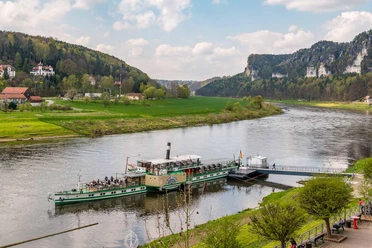
S-Bahn S1 (Meißen - Schöna) to Kurort Rathen
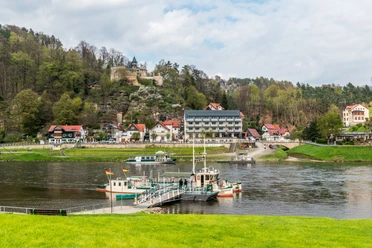
then cross with the ferry to the other side of the Elbe (this ferry is not included in the guest card mobil!)
Departure by public transport:
S-Bahn S1 from National Park Station Bad Schandau