Mill romance in the Polenz valley


- 2:55 h
- 11.01 km
- 126 m
- 128 m
- 278 m
- 404 m
- 126 m
- Start: Polenz village, Schmiede bus stop
- Destination: Polenz village, Schmiede bus stop
In the Polenz valley, we find one of the largest natural occurrences of spring snowflake flowers in Saxony. The strongly meandering Polenz flows through the valley, providing the meadows with necessary moisture. The groundwater level is very high, so there is plenty of moisture. Artificial irrigation ditches at the boundary between hillside forest and meadow favor the microclimate. The wet meadows offer ideal conditions for these early bloomers, which flower between early March and early April. Historical records show that these meadows were mowed twice a year around 1500 to harvest hay. The regular late first cut at the end of June favored seeding and thus the spread of the spring snowflakes. Around 1900, this became a tourist attraction. The Saxon Homeland Protection Association acquired about 2 hectares of meadows and 1 hectare of forest below the Bockmühle in 1928 and initiated the first protective measures. It is designated as the spring snowflake meadow nature reserve. To preserve this special natural spectacle, everyone should adhere to not entering the meadows.

Good to know
Best to visit
Directions
From the "Schmiede" bus stop in Polenz, we immediately cross the Gottleuba bridge. There we meet the Polenztal hiking trail marked with a "red dot." We walk downstream along the Polenz, first on the asphalted residential street, then it becomes a small meadow path directly beside the Polenz.
The name Polenz, or "Poliza," comes from Slavic and means something like "field brook." In the fish-rich Polenz live endangered species like the bullhead. Otters and beavers have also been documented. Birds found here include white-throated dipper, kingfisher, grey wagtail, and black stork. There is also evidence of eight bat species. Over the years, smallholders settled by the Polenz stream. Agriculture and crafts developed. The water power of the Polenz was used, and in the past, three mills were established, the last of which ceased production as a gristmill only in 1992.
Our path winds with small ascents and descents through the Polenz valley, past small granite rocks and wide meadows. On the opposite river bank, we see the Waldmühle through the trees, pass the Knochenmühle, until we reach the Bockmühle (restaurant) down in the valley.
The Bockmühle is named after a miller named Bock, who already operated the mill here with his family in the 16th century. The name remained, although in the following centuries millers with other names ran the mill. In 1876/77, the inn "Bockmühle" was built. The mill property then consisted of a farm, as well as a grinding and cutting mill.
From the Bockmühle, we walk a little back uphill to the turnoff to Neustadt. Our path is marked with a green stripe. A beautiful forest path, partly over roots and with steeper climbs, leads through the Hohes Birkigt landscape conservation area. Here the forest restructuring is in full progress, but the trees with our marking (green stripe) have been cut so that the marking is still visible and the path can be easily found.
In the middle of the forest, you come across an elaborately crafted wooden cross, which has been here since 1922. The memorial cross is dedicated to the Bautzen natural scientist and local historian Professor Guido Lamprecht (1856-1922), who suffered a heart attack here during his annual spring excursion.
Afterwards, it goes a bit further through the forest until we reach the asphalted bike path (Cunnersdorfer Straße). Towards Polenz/Neustadt, we still pass a historic milestone under monument protection. It was erected in 1820 at a junction of significant paths. The Pirnaer Steig (today a plowed field) was used by Neustadt linen weavers to bring their goods to the Pirna fairs. Another path led downstream via Niederpolenz to Bischofswerda. The direction towards Ehrenberg (Schuhmanns Grund) is now developed as a bike path. The former "communication path" from Polenz to Cunnersdorf is now also a bike path.
We stay on this bike path until Polenz. Those who parked their car at the outdoor pool turn right onto Flämmigtweg in the village. To the bus stop, go left on the street "Obere Siedlung" to Mittelweg.
Tour information
Cultural Interesting
Loop Road
Stop at an Inn
Tour with Dog
Directions & Parking facilities
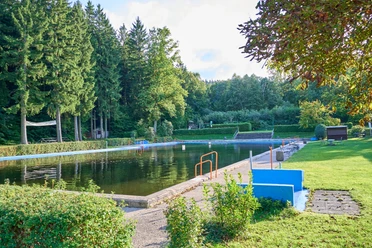
Parking lot at the Polenz outdoor pool. To the starting point of the hike, follow Flämmigtweg towards the village and continue straight on the street "Obere Siedlung" to Mittelweg. There, you will meet the Polenz river and the Polenztalweg marked with a "red dot".
Bus 261 from Dresden Central Station towards Sebnitz/Neustadt; Bus 261 from Sebnitz and Neustadt towards Dresden or Bus 234 from Pirna towards Neustadt to the Polenz/Schmiede stop
Additional information
This route is suitable for families and also for dogs. Attention: On the hiking trail to Knochmühle, several tree trunks lie across the path. With a stroller, the route is not doable.
Nearby


Download GPX file